Wave 3 · Preprint · Dataset frozen 14 October 2026
EU AI Act Transparency Audit: what 26 AI model providers publish under the Act's transparency duties
A documents-only audit of what 26 providers of general-purpose AI models publish under the EU AI Act's transparency duties, read from their own public documents and checked against the date each duty falls due. Of the 21 providers whose training-content summary deadline had passed for the model studied, 11 published a summary that presents itself as such and opens without an account, on the final, exploratory coding (7 of 21 on the coding fixed before collection). In the places we looked, we found no published Commission list of models with systemic risk.
Figure 1
Where the summary deadline had passed: what 21 providers publish
Providers whose training-content summary was due for the model studied, by what we found. Final, exploratory coding; 7 of 21 on the coding fixed before collection. This study does not determine compliance.
AI Tools Police, EU AI Act Transparency Audit wave 3, dataset frozen 14 October 2026, final coding 16 October 2026. Paper, Table 5.
View the data
| What we found | Providers |
|---|---|
| Published a summary that presents itself as such and opens without an account | 11 of 21 |
| Published a related document only | 4 of 21 |
| Nothing found in the places we looked | 6 of 21 |
Abstract
Since 2 August 2025 the EU AI Act has required providers of general-purpose AI models to publish a summary of the content used to train them; models placed on the market before that date have until 2 August 2027. For one model per provider, we ask whether that summary is published, whether anyone can open it without an account, and what it says, judged against its due date; and what providers publish about telling people they face an AI and about marking AI output.
We read the websites of the 26 providers on a list built in advance from two public platform rankings, between 7 October 2026 and 12 October 2026, and again on 14 October 2026, coding each answer from the provider's own documents under a protocol fixed and hash-recorded before collection and published with the dataset. The products studied were not tried. Every reading was AI-assisted, and 13 providers were read twice, blind.
The central result, on the study's final, exploratory coding, is this. Of the 21 providers whose summary deadline had passed for the model studied, 11 published a summary that presents itself as such and opens without an account (7 of 21 on the coding fixed before collection; Annex E). The final coding applies a broader identification rule than the one fixed before collection, and the summaries of Qwen and Tencent were reached only on 15 October 2026, after the collection window; Z.ai's summary names the GLM-5 family but not the model studied, and Qwen's describes the models behind its platform without naming one, so for neither can it be established from the document whether it applies to the version studied. Separately, 4 of the same 21 published a related document describing training content without presenting itself as the summary. Of the 2 providers whose deadline is 2 August 2027, 0 had published a summary. These counts hold for the provider and model pairs studied: applied a second time, the rule that picks each provider's model reached the same model for 6 of 21 providers, and another model could change which document counts.
In the group whose marking deadline is 2 December 2026, 8 of 12 providers already state that outputs are marked (less certain: our two readings agreed below the thresholds set in advance on the 2 items this rests on; Section 4.11); 9 of the 26 providers are removed from this question by a rule. 26 of 26 publish a model card or other per-model documentation and 0 of 26 a copyright policy, neither of which the Act requires them to publish (Table 13). In the places we looked, on 3 dates, we found no published list of general-purpose AI models with systemic risk, which the Act asks the Commission to publish.
The two readings' consistency was 0.893 (Krippendorff's alpha) over every answer and 0.894 over the answers both readings coded directly; it is not a measure of accuracy. Under a name-matching rule fixed in advance, 21 of the 26 providers were matched to organizations in Epoch AI's database of AI models (20 once 3 name fragments are set aside); this compares two lists and validates neither. The list is a constructed frame, not a sample; nothing here finds that any company, or the Commission, complied with or breached the law.
Key points
- On the study's final, exploratory coding, of the 21 providers whose summary deadline had passed for the model studied, 11 published a training-content summary that presents itself as such and opens without an account (7 of 21 on the coding fixed before collection; Annex E). The summaries of Qwen and Tencent were reached on 15 October 2026, after the window. Z.ai's summary names the GLM-5 family but not the model studied, and Qwen's describes the models behind its platform without naming one, so it cannot be established from either document whether it applies to the version studied.
- 4 more published only a related document, and for 6 we found nothing in the places we looked.
- The count belongs to the model studied for each provider: applied again, the rule that picks the model reached the same model for 6 of 21 providers.
- In the places we looked, we found no published list of general-purpose AI models with systemic risk.
- Nothing here is a finding that any provider, or the Commission, complied with or breached the law.
1. Introduction
The question is narrow, and it is the whole study: for each provider studied, is the document the EU AI Act requires to be public actually published, can a person outside the company open it, and what does it contain, judged against the date from which it is due?
The EU Artificial Intelligence Act (Regulation (EU) 2024/1689) set out its rules for general-purpose AI models, the large models many products are built on, in a chapter that has applied since 2 August 2025. Most duties in that chapter concern documents a provider gives to the authorities, or to other companies, on request. One is different. Article 53(1)(d) requires every provider of a general-purpose AI model to make a summary of the content used to train it publicly available. That makes the summary something any reader can look for, and so something a study can look for.
The question matters now for a plain reason. The Act's general date of application is 2 August 2026, under Article 113: "It shall apply from 2 August 2026." The earlier date for the chapter on general-purpose AI models, 2 August 2025, was set with one exception, written into the same article, Article 113, point (b): "Chapter III Section 4, Chapter V, Chapter VII and Chapter XII and Article 78 shall apply from 2 August 2025, with the exception of Article 101;" Article 101, which allows the Commission to fine providers of general-purpose AI models, was therefore held back to 2 August 2026, the same date from which the duties to tell people they are interacting with an AI system and to mark AI-generated content apply. This paper reads the public record at the moment those powers and duties have arrived; it makes no finding that bears on enforcement.
It is a question about documents, which is why documents are the data. A study that tried the products would answer a different question, and the products studied were not tried here. It reads what a provider publishes, records where it found each document and what the document says, and dates each finding. It does not judge whether any document is sufficient, and it does not say whether any company complies with the law.
Section 2 sets out what the Act asks, in plain terms. Section 3 describes the method in full. Section 4 reports the results, each under a heading that states the claim the section supports. Sections 5 and 6 give the limitations and what the results mean, and Section 7 the recommendations that follow from them. Every figure comes from the study's final analysis; Annex E gives the analysis of the coding as frozen and every value the final analysis corrects. The dataset release holds every record, every source and every table the protocol fixed; the Data availability section names each file.
2. What the Act asks providers to publish
Table 1 lists the provisions the study reads, whom each binds, whether the document must be public, and from when.
Table 1. The provisions this study reads.
| Provision | What it asks (our summary) | Whom it binds | Must the document be published? | Applies from | Later deadline for earlier models or systems |
|---|---|---|---|---|---|
| Article 53(1)(d) | Draw up and publish a summary of the content used to train the model, using the AI Office template | Providers of general-purpose AI models | Yes | 2 August 2025 | Article 111(3): models on the market before 2 August 2025 have until 2 August 2027 |
| Article 53(1)(a) | Keep technical documentation of the model, for the AI Office and national authorities on request | Providers of general-purpose AI models | No | 2 August 2025 | Article 111(3): models on the market before 2 August 2025 have until 2 August 2027 |
| Article 53(1)(b) | Give information and documentation to developers who build the model into their systems | Providers of general-purpose AI models | No | 2 August 2025 | Article 111(3): models on the market before 2 August 2025 have until 2 August 2027 |
| Article 53(1)(c) | Put in place a policy to comply with EU copyright law | Providers of general-purpose AI models | No | 2 August 2025 | Article 111(3): models on the market before 2 August 2025 have until 2 August 2027 |
| Article 53(2) | Exempts certain open-source models from points (a) and (b) | No one (an exemption) | No | 2 August 2025 | None |
| Article 50(1) | Inform people that they are interacting with an AI system | Providers of AI systems | No | 2 August 2026 | Open: whether Article 111(3) reaches it (two readings reported) |
| Article 50(2) | Mark AI-generated outputs in a machine-readable, detectable way | Providers of AI systems | No | 2 August 2026 | Article 111(4): systems on the market before 2 August 2026 have until 2 December 2026 |
| Article 50(4) | Disclose deep fakes and AI-generated public-interest text | Deployers | No | 2 August 2026 | None |
| Article 52(6) | The Commission ensures a list of general-purpose AI models with systemic risk is published | The Commission | Yes | 2 August 2025 | None |
Note: our summary of each provision; whom it binds, the publication duty and the dates come from the study's frozen register of the Act's text, checked character for character against the consolidated text. Source: the obligation register in the release.
The training-content summary. Article 53(1)(d) requires providers to "draw up and make publicly available a sufficiently detailed summary about the content used for training of the general-purpose AI model, according to a template provided by the AI Office." The AI Office has published that template (European Commission, 2025a). The Act does not define "sufficiently detailed", and this study does not judge any summary against that phrase. Article 111(3) gives models already placed on the market more time: "Providers of general-purpose AI models that have been placed on the market before 2 August 2025 shall take the necessary steps in order to comply with the obligations laid down in this Regulation by 2 August 2027." We therefore dated each model by the earliest date on which its provider's own documents state it was available to outside users (Section 3.3). A model released before 2 August 2025 owes its summary by 2 August 2027; a model released on or after that date owes it from its release; where the documents did not settle the date, the provider is reported in a group of its own.
Documents the Act does not require to be public. Article 53(1) also requires technical documentation kept for the AI Office and national authorities, information for developers who build the model into their own systems, and a policy to comply with EU copyright law, including the rights reservation of Directive (EU) 2019/790. None of these has to be published. When providers publish them anyway, we count it as voluntary publication, with no deadline, and an absence is not a missing disclosure.
Interaction disclosure and marking. Article 50(1) requires AI systems that interact with people to be designed so that people are told they are dealing with an AI system. Article 50(2) requires providers of systems that generate audio, images, video or text to mark the outputs in a machine-readable way. Both apply from 2 August 2026. A later amendment, Regulation (EU) 2026/1744, added Article 111(4), which gives systems already placed on the market until 2 December 2026 to mark their outputs. Whether Article 111(3) also delays Article 50(1) for older models is an open question, so we report Article 50(1) under both readings and decide neither. We read what providers publish about these duties; we do not test whether any marking works. Article 50(4) binds deployers, the organizations that use a system, not providers, so guidance a provider publishes for its deployers is counted as voluntary.
The Commission's list. Article 52(6) requires the Commission to ensure that a list of general-purpose AI models with systemic risk is published and kept up to date. We looked for that list as carefully as we looked for any provider's document.
3. Method
3.1 Design and window
A cross-sectional documentation audit: one collection window, every provider on the frozen list read inside it, one instrument applied to all of them. Provider pages change, so one dated reading per provider is the unit of observation, and every answer carries its own reading date. Records were read between 7 October 2026 and 12 October 2026. Every record's documents were then read again on one day, 14 October 2026, in what this paper calls the final-day re-check; the plan put it on 13 October 2026, and it ran one day late (deviation 23). After the window, on 15 October 2026, an AI-assisted re-check read again the sources of the providers whose summary deadline had passed (Section 3.7). Every statistic is descriptive. The design answers no causal question, and no figure is a trend: this is one reading.
3.2 The frame: a constructed list, not a census or a sample
The providers were chosen in three steps, under rules fixed before any was read (AI Tools Police, 2026b). Table 2 gives the numbers.
Table 2. How the list of providers was built.
| Step | Count |
|---|---|
| Candidates in the pool | 176 |
| Rejected by the eligibility tests | 131 |
| Candidates that passed | 45 |
| Providers those candidates make up | 31 |
| Providers with a position on at least one ranking (the list studied) | 26 |
| Eligible providers with a position on neither ranking | 5 |
| Providers with a system studied | 19 |
| Providers for whom no system qualified | 7 |
Note: counts from the freeze record and the frozen list. Source: the freeze record and the analysis program's frame output.
First, candidates came from 7 public source pages: the 2 ranking platforms described below (Hugging Face, n.d.a; OpenRouter, n.d.a), 1 Commission page on the general-purpose AI code of practice (European Commission, n.d.e), and 4 catalog pages of 3 cloud services (Amazon Web Services, n.d.; Google, n.d.b; Microsoft, n.d.a; Microsoft, n.d.b); the pool closed on 29 September 2026. Second, eligibility tests ran from 29 September 2026 to 1 October 2026: a candidate entered only if its own English-language pages showed that it provides a general-purpose AI model, with a few logged cases decided on less than the candidate's own pages, or on a judgment. For 88 of the rejected candidates, the reason was that their own pages did not settle whether their model is general-purpose. Several candidates can belong to one company, which is why the candidates that passed make up fewer providers.
Third, the eligible providers were ranked on two public measures of how their models are distributed. One is the sum of the monthly download figures shown on the providers' model pages on Hugging Face (Hugging Face, n.d.b), read on 1 October 2026. The other is the number of tokens, the units of text a model processes, that the OpenRouter marketplace reports for each provider's models over a 7-day window, read on 1 October 2026 (OpenRouter, n.d.b). Neither measure shows size, revenue or importance: a download is a copy of a model file, not a user. Each provider took its better position; the rules admitted up to 50 providers, and every eligible provider with a position entered. The result is the 26 providers in this audit's ranked frame, frozen on 7 October 2026 before any document was coded.
The list is not neutral and supports no claim beyond itself. It is built from two platforms' figures, so it favors providers whose models are distributed through them, and it says nothing about providers below the cut. As a rough check on what a ranked list leaves out, the plan compares it with Epoch AI's public database of AI models (Epoch AI, 2026). Under the matching rule fixed before the comparison, 36 of the 1031 organizations in that database were matched to 21 of the 26 providers. 3 of those matches were fragments of company names, such as "Inc"; with them set aside, in a figure computed after the first was known, 33 of 1028 organizations match 20 providers (deviation 29). The rule matches names letter by letter and so cannot see a parent or brand name, such as Meta's or Alibaba's (deviation 30). The database describes itself as "The list of models is non-exhaustive, but aims to cover most models that were state-of-the-art when released, have over 1000 citations, one million monthly active users, or an equivalent level of historical significance." A provider not matched under the rule is not matched under it, and nothing more.
3.3 The instrument
The codebook is the measurement instrument (AI Tools Police, 2026c). It defines 48 coded items in nine areas: the training-content summary, the copyright policy, technical documentation and the open-source exemption, interaction disclosure, marking, guidance for deployers, what providers say about their own role under the Act, pages in other languages, and providers' own readings of terms of the Act. Each item has a closed list of answers, a decision rule, the kinds of page to read in order, and worked boundary cases. No item was added, removed or redefined after collection began, except that the final coding broadened the decision rule of the summary item, as the next paragraphs and Section 3.7 set out.
For each provider the frozen list fixed one model to study, which we call the model studied, and, where one qualified, one AI system offered to the public, such as a chat application, which we call the system studied. These choices fix which release date sets the deadline and which system the Article 50 questions are asked about. They are not claims that one model or system stands for everything a provider offers.
A document counts as identified as the summary when it presents itself as the summary of the content used to train the model. The codebook, fixed before collection, accepted four routes: the document names Article 53(1)(d), it names the AI Office template, its own title presents it as such a summary of a named model, or its opening sentence says so. The final coding applies one broader rule to every provider whose deadline had passed: a document presents itself as the summary where its title or its body says so, where it names Article 53(1)(d) or the AI Office template, or where it follows the template's section structure (deviation 36). A document that describes the model's training content but presents itself in none of these ways is a related document. Whether a document names the model studied is recorded apart: by its exact name, or not by name, where the document names only the model family or describes the provider's models in general; then whether it applies to the version studied cannot be established from it. Whether a related document, or a summary of a family, can be the summary the Act requires for a specific model is an open legal question, so related documents are counted on their own and never added to the summaries, and summaries that do not name the model studied are reported beside the count. The related documents of the providers outside the passed-deadline group, 2 whose deadline is 2 August 2027 and 1 whose release date was not settled, were coded under the codebook's routes only.
Every count about a duty is split by deadline group, computed from the provider's documented release date and the date we read the record: the deadline had passed; the deadline had not yet arrived; or the documents did not settle the release date. A group is a computation, not a judgment.
The release date is a proxy. The Act's duties attach to placing a model on the market in the Union, which a reader outside the company cannot observe. The study dates each model by one rule. The model's date is the earliest date on which the provider's own documents state that the model was available to users outside the company. A date called a "release date" that states no outside access does not qualify. Where two documents of the same standing give different dates, the date is recorded as conflicting, and the provider is reported in the group whose release date is not settled. The date so found is read as if it were the date of placing on the Union market. Where a model reached the Union after it was released elsewhere, the proxy dates it too early. That can put its provider in the passed-deadline group before the Act would, or, where the release elsewhere came before 2 August 2025 and the Union placing after it, in the group given until 2 August 2027 although the duty applied from the Union placing. Annex A prints the date the proxy takes for every model, with the deadline it sets. The second reading of Article 50(1), under which Article 111(3) delays that duty for older models, adds an assumption of its own: that the release date of the model studied stands for the system built on it. The Act states no such link, and the groups under that reading rest on it.
3.4 What was read, and what was prohibited
We read the provider's own public pages of nine kinds: the main website; legal, policy and trust pages; any page about the EU AI Act; model cards and other documentation of the model; developer documentation; the help center; the blog or newsroom; research papers the provider links; and the product page of the system. Each page was read in a real browser, and a copy of every page read was saved with its SHA-256 fingerprint. Pages behind a login or another barrier are reported apart from absences.
The documents-only rule prohibited, at every step: opening an account of any kind; signing in; filling in or submitting any form; starting a chat, a call or a purchase; typing into any search box on a provider's site; using any model or product; and contacting any provider or the Commission during the window. One breach is recorded: during the final-day re-check, a press of several controls on a Microsoft support page included controls that start a chat or a call. Nothing opened, nothing was typed, and no answer rests on that page (deviation 26).
We opened no search box on any provider's site. We found documents by following links, and we recorded separately whether each could be reached within three clicks of the home page. Within the window the study's only search was for the Commission's list, in the EU's law database; a general web search for the list was run at the first read, on 11 September 2026, before the window (Table 14). The AI-assisted re-check after the window also ran limited searches of providers' own domains, as its notes record. We read English-language pages. "Nothing found in the places we looked" is a recorded result, and it means exactly that: on the date in that row, in those nine kinds of page, we did not find the document. It does not mean the document does not exist.
3.5 Who coded, and what the consistency figure measures
This study is AI-assisted research under named editorial control. One AI service carried out every reading in the window, first, second and adjudicating, under the documents-only rule, and a separate AI-assisted methods review read the plan, the collection rules and the paper adversarially. The AI-assisted re-check after the window, the two readings of deviation 38, the two readings and adjudication of deviation 39 and the two readings of deviation 40 are described in Section 3.7 and Annex B. The author fixed the question and the design, approved the protocol documents, and signed off the frozen dataset before publication.
The reliability figure is therefore reported as consistency between two independent readings, never as agreement between human coders. Two AI-assisted readings of the same pages, made by one service, can make the same mistake; where they do, they agree, the statistic rises, and accuracy does not. The figure shows that the instrument was applied consistently, not that it was applied correctly. Some answers are set by a codebook rule rather than coded, so two readings that agree on what triggers the rule agree on those answers automatically; the paper therefore also reports consistency over the answers both readings coded directly (Section 4.11). The protocol fixed the thresholds in advance: an item is flagged where Krippendorff's alpha, a standard agreement statistic (Krippendorff, 2019), falls below 0.667, or where the readings agree for fewer than 80% of providers.
3.6 Second coding, adjudication and blindness
A rule fixed in the protocol before any document was read chose 14 providers for a second, independent reading. Tencent left that group when its first reading was withdrawn twice, because collapsed answers on a read page could bear on the summary and had not been opened (deviation 22), so 13 providers were read twice. The second reading saw no answer of the first, no record of another provider and none of our own published pages, as each reading attested; the blindness was attested, not enforced by the system. Where the two disagreed, an adjudicating reading, blind on the same terms, read both records and both sets of sources and applied the codebook's decision rule. The published records come from the adjudicating reading for 11 providers and from the first reading for 15; among the latter, Moonshot AI and NVIDIA were read twice with no disagreement.
The blindness record. In 14 cases a reading reported that it had seen something outside its own provider's files, such as a list of file names, a count of files or the reading program's own source. A disclosure naming an answer, note, copy or page of the other reading of the same provider would have voided the reading; none did, so each reading stands. The 2 readings set aside were both Tencent's, for the reason above.
The final-day re-check and the re-readings. In the final-day re-check, on 14 October 2026, every record's documents were read again. Where it found a change that could bear on an answer, the record was read again in full: this happened for 4 providers, Anthropic, Cohere, Google and OpenAI. The study set the rule for these re-readings after their answers were known: a later reading replaces the earlier record only where a change the final-day re-check found in a provider's pages alters the answer it bears on (deviation 32). No change it found altered the answer it bore on, so the earlier records are published and the re-readings are kept beside them. The re-readings themselves differ from the published records on 12 answers, all listed in the release. The changes the final-day re-check found are reported as findings: Anthropic had rewritten the disclosure sentence of its acceptable use policy, and OpenAI's help article on the EU AI Act carried a new update date. For Cohere and Google it showed no change by the provider: one copy held only the site's navigation, and one showed content behind controls the earlier readings had not opened. On its own web crawling for training and its reading of what "as far as technically feasible" means for marking, Google's original record reads "Nothing found in the places we looked" while its re-reading found text; these 2 answers reflect the earlier reading, not an absence on Google's pages, and the final analysis applies the re-reading's values (deviation 34).
3.7 The original record, the correction record and the final analysis
The study keeps three records apart. The original record is the frozen records, one per provider, each answer as the reading coded it, signed off by the author before publication; the release's coded-value files carry it unchanged. The correction record lists every value the final analysis applies in place of an original one, with both values and the deviation each rests on: 37 entries, 35 of which change a value, for 7 providers (Table E4). Each applies a ruling of the deviations log to a published record (Cohere, deviation 33), takes the value the re-reading of 14 October 2026 found (Google, deviation 34), applies the broader identification rule to every provider in the group alike (deviation 36), counts a document our reading reached only after the window (deviations 36 and 37), codes the content of such a document from the study's own copy (deviation 38), or takes a value coded again by two blind readings (deviation 39 for Sakana AI's release date, deviation 40 for which models Qwen's summary names). Apart from Qwen's and Tencent's, whose summaries were read only after the window, none depends on what a provider's page showed after the window. The final analysis is the analysis program run over the original records with the correction record applied by program, and every figure in this paper comes from it unless the text says otherwise.
The headline item was re-coded after an external review. After an external review of an earlier version of this paper, and after every value was known, the item on whether a summary is published was coded again under the one rule set out in Section 3.3, applied to every provider whose deadline had passed (deviations 34 to 37). It is reported as the study's final, exploratory coding (protocol section 10.6), and the count on the coding fixed before collection stands beside it wherever it is the headline, and in Annex E. The re-coding rests on an AI-assisted re-check of the sources of the 21 providers whose deadline had passed, read on 15 October 2026. The AI-assisted re-check was not blind to the study's codes, was not time-limited, read after the window closed, and was not matched to the frozen copies; it answered apart whether each document presents itself as the summary and whether it names the model studied (Section 4.3). The author reviewed and confirmed its 21 rows on 15 October 2026; the confirmation is recorded in the study's log, not in the re-check file, whose review fields were left unchanged. Its readings changed the records of Microsoft, Qwen, Tencent and Thinking Machines Lab: those of Microsoft, Qwen and Thinking Machines Lab because the final coding applies the broader identification rule, not because an earlier reading was in error, and those of Qwen and Tencent because the re-check reached documents our reading had not; Qwen's move counts under both (deviation 37). Qwen's values rest on the study's own copy of its summary page, saved by its reader on 15 October 2026, and Tencent's on the study's own copy of its summary file, saved on 16 October 2026, identical by SHA-256 to the file the AI-assisted re-check opened. The AI-assisted re-check's own saved copies stay with the study and are not republished.
The content of the two summaries reached after the window. The content items of Tencent's and Qwen's summaries were coded from those copies by two readings under the codebook, each blind to the other, which agreed on 10 of 10 values, so no adjudication was needed (deviation 38). Two points of that coding are reported here once: Tencent's kinds of content rest on the boxes its summary ticks, which mark text only, and Qwen's named sources are two of its own models, named as generators of synthetic data.
3.8 The index and its sensitivity analyses
The study scores one thing, with an index the codebook names the Public Determinability Index for the Article 53(1)(d) summary: what a reader outside the company can establish about a document the Act requires to be public. It scores the public record, not the quality or adequacy of the content, and it scores no compliance. Its items and points, in Table 3, were fixed before any document was read. A provider with no document scores at the bottom of the scale, and a provider whose deadline has not arrived owes no summary yet, so a low band there is not a shortfall. The scores fall into five bands whose names describe the public record: full, substantial, partial, thin and minimal.
Table 3. The index items and their points.
| Item | Maximum points |
|---|---|
| Training-content summary | 25 |
| The document names the model it covers | 15 |
| The document states the kinds of training content | 10 |
| The document states the categories of sources | 15 |
| The document names particular sources | 10 |
| The document refers to the AI Office template | 10 |
| The document carries a date or a version | 15 |
| Total | 100 |
Note: each answer's points are fixed in the codebook; an answer the study could not determine scores zero and stays in the denominator, and the count of such answers is printed beside the index wherever it bears on it. Source: the analysis program's index output.
The weights are a fixed choice. The codebook set them before any document was read. Within an item it fixes the order of points: a published answer scores highest, a statement that the provider does not publish about a third of the item, documents that disagree about a fifth, and an answer that is absent or could not be settled scores nothing. Whether a summary is published and open carries the most points, and what it says shares the rest. The sensitivity analysis with equal weights shows how far the choice moves the index (Section 4.12).
Six sensitivity analyses were fixed in the protocol before collection. Two recompute the index: with equal weights for its items, and with every statement of non-publication scored zero. Four recompute the training-content figures for a subset or under another reading: signatories of the general-purpose AI code of practice, as the frozen list recorded them from Commission materials before any answer was coded; providers whose deadline had passed; the most favorable reading, under which an answer we could not open counts as found; and release dates assigned from a period, such as a season. None replaces a published figure or reorders a table (Section 4.12).
3.9 Departures from the plan, by class
The deviations log records 40 numbered departures and 4 notes, each dated, each stating what it changed, and the plan itself was never edited. Table 4 groups them; Annex B gives each in plain words.
Table 4. Departures from the plan, by class.
| Class | Deviations | Count | Of which corrections of an earlier reading or rule |
|---|---|---|---|
| Building the list of providers | 1 to 10 | 10 | 5 |
| Rules for the readings, their blindness and what counts as a provider's document | 11 to 22 | 12 | 2 |
| The collection window, the final-day re-check and which record is published | 23, 24, 25, 26, 27, 28, 32, 33 | 8 | 4 |
| The outside comparison and the paper's own checks | 29 to 31 | 3 | 0 |
| The external review, the AI-assisted re-check and the final coding | 34 to 40 | 7 | 2 |
| All | 1 to 40 | 40 | 13 |
Note: classes group the log's own entries by subject; the kind of each entry is the log's, except deviation 36, which deviation 37 describes as a re-coding under a broader identification rule rather than a correction. Source: the deviations log in the release.
Several departures were decided after the answers they bear on were known, and Annex B says so for each. These are the ones a reader may wish to open first. Deviations 1 to 4 corrected and widened the eligibility tests after the candidate pool and many decisions were known. Deviation 25 coded Z.ai's record again after its answers were known, and the summary still counts as identified (Section 4.3). Deviation 32 set the rule for the re-read records after their answers were known. Deviations 34 to 37 revised the analysis after reviews of an earlier version of this paper, deviation 36 re-coded the headline item, and deviation 38 coded the content of the two summaries reached after the window (Section 3.7 and Annex E).
Where the study holds two versions of a record, for the 4 providers read again and for Z.ai's record coded again, the analysis compares them answer by answer, and none of the differences changes which providers count in the headline figure. The re-coding of deviation 36 does change it, and Annex E sets the two analyses side by side. For the other departures the study holds no second version to compare, so their effect on the headline figure is not known.
3.10 Reporting rules
Fixed in the protocol before collection, these shape how this paper reads. Every share prints with its denominator, as "x of n"; percentages appear only for groups of 5 or more. Every count about a duty prints its deadline group, and no count pools two groups. Counts of documents the Act does not require to be public carry no deadline group. Providers a codebook rule removed from a question are printed beside the count as "removed by a rule" and leave its denominator. Every table about what providers publish carries the note "What is published and reachable, as read on the dates in each row. This study does not determine compliance." Every finding that rests on a flagged item carries a short caveat beside it. Per-provider tables are sorted by the study's provider identifier, never by score. No sentence says that any provider, or the Commission, complied with or breached the law.
4. Results
4.1 Where the deadline had passed, some providers publish a summary that presents itself as such, and for others we found nothing (exploratory)
This section reports the study's final, exploratory coding (protocol section 10.6), which applies the broader identification rule of Section 3.3 and counts documents reached after the window. The protocol fixes, word for word, a canonical sentence for the headline figure. Its words "at our read" would not hold for documents opened after the window, so it is printed in Annex E, filled on the coding fixed before collection, where every word of it holds.
On the final coding, of the 21 providers whose Article 53(1)(d) duty had already fallen due, 11 published a training-content summary that served live and that could be reached without an account (7 of 21 on the coding fixed before collection; Annex E). For 9 of them the document was read within the window, and for Microsoft and Thinking Machines Lab among them it counts as the summary only under the broader rule of the final coding; for Qwen and Tencent the document itself was reached on 15 October 2026, after the window. Of the 2 providers whose duty does not fall due until 2 August 2027, 0 published one, and for 3 the documents did not settle the release date. Table 5 breaks the same figures down by what we found, group by group.
Table 5. Training-content summaries, by deadline group.
What is published and reachable, as read on the dates in each row. This study does not determine compliance.
| What we found | Deadline had passed (n = 21) | Not yet due, deadline 2 August 2027 (n = 2) | Release date not settled (n = 3) |
|---|---|---|---|
| Published, identified as the summary | 11 | 0 | 0 |
| Related document only | 4 | 2 | 1 |
| The provider states it does not publish this | 0 | 0 | 1 |
| Nothing found in the places we looked | 6 | 0 | 1 |
| Removed by a rule | 0 | 0 | 0 |
Note: each cell counts providers; each column is one deadline group, with its own number of providers (n). Source: the analysis program's frequency output, final analysis.
The 11 providers with an identified summary, whose deadline had passed, are Anthropic, Cohere, DeepSeek, Microsoft, MiniMax, NVIDIA, OpenAI, Qwen, Tencent, Thinking Machines Lab and Z.ai. The summary names the model studied for 9 of them. For the other 2, Z.ai's summary names the GLM-5 family but not the model studied, and Qwen's describes the models behind its platform without naming one, so for neither can it be established from the document whether it applies to the version studied (deviation 40). For 2 providers, Baidu and Meta, the deadline is 2 August 2027, and anything published now was published before it: 0 of the 2 published an identified summary, and 2 of the 2 a related document; whether such a document could serve as the summary the Act will require is the open question of Section 3.3. For 3 providers, Dolphin AI, Mistral AI and Salesforce, the documents did not settle the release date; 0 published an identified summary and 1 a related document.
Tencent's transparency center linked a training-content summary for its model studied, Hy4 preview, during the window (Tencent, n.d.b). The linked page was a PDF viewer that held no text, and the study's reading tool did not read the file (deviation 24 (c)). The AI-assisted re-check opened the file directly on 15 October 2026, and the study saved the same file on 16 October 2026 (Tencent, n.d.a). It is headed "Public Summary of Training Content for Hy4 Preview", and its file name dates it 28 August 2026. The final coding counts it as a summary that names the model studied, and its content was coded from the study's copy (deviation 38).
During the window, the footer of Qwen's home page showed the words "Training Data Summary" as plain text, with no link our reading recorded (Qwen, n.d.a), and the reading coded a summary mentioned with no location a reader can reach. After the window, on 15 October 2026, the study's own reader saved a training-content summary page on Qwen's site (Qwen, n.d.b); it describes the models of Qwen's platform without naming the model studied, Qwen3.8-Max. The Internet Archive's Wayback Machine index (Internet Archive, n.d.) lists the page's address with status 200 on 25 July 2026, 2 August 2026 and 26 August 2026, and on no date within the window: the address existed before the window, but no capture dates the page's content within it. The final coding counts it as a summary that describes the models behind Qwen's platform without naming one, by both the reading's later reach and the broader identification rule (deviations 36 and 37), and its content was coded from the study's copy (deviation 38).
Of the 15 providers in the passed-deadline group with a document address, 15 served live: Qwen's on 15 October 2026, and Tencent's on 15 October 2026 (opened by the AI-assisted re-check; the study saved the identical file on 16 October 2026); none was reached only through an archive copy. Of the 15 providers in that group whose summary or related document we located, the link crawl did not reach the document within three clicks of the home page for 2, and could not be completed, or was not run to a document reached after the window, for 9. Every provider's answer, with the document read and the release date that sets its deadline, is in Annex A.
4.2 Related documents describe training content without presenting themselves as the summary, and are counted apart
4 of the 21 providers whose deadline had passed published a related document, as did 2 of the 2 whose deadline is 2 August 2027 and 1 of the 3 whose release date was not settled. Table 6 lists them with what each document states.
Table 6. Related documents: what each states.
What is published and reachable, as read on the dates in each row. This study does not determine compliance.
| Company | Deadline group | Document read | Names the model it covers | Categories of sources | Named sources | Date or version |
|---|---|---|---|---|---|---|
| Baidu | Not yet due | (Baidu, n.d.) | Names specific models | Lists them | Gives examples of kinds of source only | Dated, no version |
| Deadline had passed | (Google, n.d.a) | Names specific models | Not stated in the document | Names no source | Dated, no version | |
| inclusionAI | Deadline had passed | (inclusionAI, n.d.) | Names specific models | Lists them | Names datasets | Dated and versioned |
| Meta | Not yet due | (Meta, n.d.) | Names specific models | Lists them | Names websites or licensors | Neither dated nor versioned |
| Sakana AI | Deadline had passed | (Sakana AI, n.d.) | Names specific models | Lists them | Gives examples of kinds of source only | Dated, no version |
| Salesforce | Release date not settled | (Salesforce, n.d.) | Names specific models | States them in general terms | Names datasets | Neither dated nor versioned |
| Upstage | Deadline had passed | (Upstage, n.d.) | Names specific models | States them in general terms | Names no source | Neither dated nor versioned |
Note: sorted by the study's provider identifier. "Names the model it covers" records whether the document names specific models, not whether it names the model studied: inclusionAI's report names specific models but names the model studied only by its family (Table 7). Source: the final records.
Caveat: on the item "the document names particular sources", the two independent readings agreed for 10 of 13 providers (76.9%), below the 80% agreement threshold; Krippendorff's alpha was 0.694. The thresholds were fixed in advance, so figures resting on this item are less certain (Section 4.11).
Across summaries and related documents in the passed-deadline group, the document names the specific models it covers for 13 of 21 (61.9%) providers (for inclusionAI, not the model studied; Table 7) and lists the categories of sources for 13 of 21 (61.9%). It names particular datasets for 10 of 21 (47.6%) (less certain: our two readings agreed below a threshold set in advance on the item this rests on; Section 4.11). It names and cites the AI Office template for 1 of 21 (4.8%), and carries both a date and a version for 11 of 21 (52.4%). For 6 of 21 (28.6%) there was no document to read. These counts describe what the documents state, not whether it is sufficient.
4.3 Whether a document presents itself as the summary is kept apart from whether it names the model studied (exploratory)
The AI-assisted re-check of 15 October 2026 read the sources of every provider whose deadline had passed and answered two questions apart: whether the document presents itself as the summary, under the rule of Section 3.3, and whether it names the model studied by its exact name. Table 7 gives its reading for each provider, with the document it read and where. The final coding takes the first answer for every provider in the group; the second is reported beside it and changes no count.
Table 7. The AI-assisted re-check: does the document present itself as the summary, and does it name the model studied?
What is published and reachable, as read on the dates in each row. This study does not determine compliance.
| Company | Document, as the AI-assisted re-check describes it | Where the AI-assisted re-check read it | Presents itself as the summary | Names the model studied | Final coding |
|---|---|---|---|---|---|
| Anthropic | Public Summary of Training Content: Claude Opus 5.5 | The cover and section 1.2, PDF pages 1 and 2 | Yes | Yes, by its exact name | Published, identified as the summary |
| ByteDance Seed | SeedRealtime model announcement | The announcement's heading and the model names in the Transparency list | No | Yes, by its exact name | Nothing found in the places we looked |
| Cohere | Training content summary for Command A+ and its family | PDF page 1, section 1.2 | Yes | Yes, by its exact name | Published, identified as the summary |
| DeepSeek | DeepSeek-V4 training content summary | PDF page 1, section 1.2 | Yes | Yes, by its exact name | Published, identified as the summary |
| Gemini 3.8 Flash model card | The model card's description and training data sections | No | Yes, by its exact name | Related document only | |
| inclusionAI | Ming-Flash-Omni technical report | PDF page 1 and the full text; also LEGAL.md | No | No; names its model family only | Related document only |
| Liquid AI | LFM2.5-230M product documentation | The model page opened from the model catalog | No | Yes, by its exact name | Nothing found in the places we looked |
| Meituan | LongCat changelog | The LongCat-2.5-Preview announcement; the terms of use | No | Yes, by its exact name | Nothing found in the places we looked |
| Microsoft | Data Summary for MAI-Thinking-1 | PDF page 1, sections 1.1 to 1.3, and the structure of data sources that follows | Yes | Yes, by its exact name | Published, identified as the summary (originally: related document only) |
| MiniMax | MiniMax H3 training content summary | PDF page 1, the heading and section 1.2 | Yes | Yes, by its exact name | Published, identified as the summary |
| Moonshot AI | Kimi K3 model card | The Hugging Face model card's heading and sections | No | Yes, by its exact name | Nothing found in the places we looked |
| NVIDIA | NVIDIA Nemotron training content summaries | PDF pages 18 and 19, the Nemotron 3.5 model list | Yes | Yes, by its exact name | Published, identified as the summary |
| OpenAI | GPT-6 Astra training content summary | PDF page 1, section 1.2 | Yes | Yes, by its exact name | Published, identified as the summary |
| Perceptron | Perceptron Mk1.5 product documentation | The product document's heading and model identifier field | No | Yes, by its exact name | Nothing found in the places we looked |
| Qwen | Training Data Summary | The body of the summary, opened after the window from the link then at the foot of the home page | Yes | No; describes its platform's models without naming one | Published, identified as the summary (originally: summary mentioned, with no location a reader can reach) |
| Sakana AI | Sakana Fugu technical report | PDF page 1 and the full text; the Sakana Chat terms | No | Yes, by its exact name | Related document only |
| StepFun | Step 3.7 Flash model announcement | The model announcement's heading and the terms of use | No | Yes, by its exact name | Nothing found in the places we looked |
| Tencent | Hy4 Preview training content summary | PDF page 1, the heading and section 1.2 | Yes | Yes, by its exact name | Published, identified as the summary (originally: could not be opened) |
| Thinking Machines Lab | Inkling-Small training content summary | PDF page 1, the heading and section 1.2 | Yes | Yes, by its exact name | Published, identified as the summary (originally: related document only) |
| Upstage | Solar Pro 4 model announcement | The announcement's heading and the terms of use | No | Yes, by its exact name | Related document only |
| Z.ai | GLM-5 family training content summary | PDF page 1, section 1.2, and a search of the full text | Yes | No; names its model family only | Published, identified as the summary |
Note: the descriptions and locators are the AI-assisted re-check's own, translated into English; a description is not a quotation of the document's title. The re-check did not code whether its documents describe training content, so the split between related documents and nothing found rests on the original reading. Source: the re-check output and the final records.
Under that rule, 9 of 21 documents present themselves as the summary and name the model studied, 2 of 21 present themselves as the summary but do not name the model studied, and 10 of 21 do not present themselves as the summary: 4 are the related documents of Table 5, and 6 are model cards, announcements or product pages; for these 6 the original reading found no document describing training content. The re-check finds a summary where the original coding counted none for 4 of 21 providers, Microsoft, Qwen, Tencent and Thinking Machines Lab, and finds none where the original coding counted one for 0 of 21. Microsoft's document (Microsoft, n.d.c) calls itself a data summary, names the model studied in its heading and follows the template's sections; Thinking Machines Lab's (Thinking Machines Lab, n.d.) names the model studied in its section on model identification. Z.ai's summary (Z.ai, n.d.) counted under both codings, as naming a model family: it names GLM-5, GLM-5.1, GLM-5.2 and GLM-5.3, not the model studied, GLM-5.3-Flash, and its date line reads "Last update: 21/08/2026", before that model's earliest documented date of outside access, 26 August 2026 (deviation 25). In its answer on modified or fine-tuned models, the Commission's questions and answers on the template say: "Different models or model versions may be covered by the same Summary, if the content of their Summaries is identical. In such cases, it should clearly specify which models and model versions the Summary applies to." (European Commission, 2026) Neither Qwen's nor Z.ai's summary specifies the model studied. The study does not judge whether either summary follows that guidance. The records of Microsoft, Tencent, Thinking Machines Lab and Z.ai, at the boundary the re-coding settled, were read once in the window; the AI-assisted re-check (Section 3.7) is the only other reading of them.
4.4 A different choice of model could change which documents count (exploratory)
The rule that picks each provider's model was applied a second time, independently, for 21 providers. It reached the same model for 6 of them. One of those, inclusionAI's, matches only once a hyphen and a space are read alike ("Ming-flash-omni-Preview" and "Ming-flash-omni Preview"), so letter for letter the same model was reached for 5 of 21; the two counts describe one comparison. Table 8 gives each pair.
Table 8. The model studied and the model the rule reached when applied again.
What is published and reachable, as read on the dates in each row. This study does not determine compliance.
| Company | Model studied | Model reached when the rule was applied again | Same model | Training-content summary, final coding | Model reached again named in that document |
|---|---|---|---|---|---|
| Anthropic | Claude Opus 5.5 | Claude Sonnet 5.5 | No | Published, identified as the summary | No |
| Baidu | ERNIE-4.5-0.3B | None reached | No | Related document only | No model reached |
| ByteDance Seed | SeedRealtime | SeedRealtime | Yes | Nothing found in the places we looked | Same model |
| Cohere | Command A+ | Command A+ | Yes | Published, identified as the summary | Same model |
| DeepSeek | DeepSeek-V4-Flash | DeepSeek-V4.1-Flash | No | Published, identified as the summary | No |
| Dolphin AI | Dolphin Mistral 24B Venice Edition | None reached | No | Nothing found in the places we looked | No model reached |
| Gemini 3.8 Flash | Gemini 4 Argon | No | Related document only | No | |
| inclusionAI | Ming-flash-omni-Preview | Ming-flash-omni Preview | Yes, once a hyphen and a space are read alike | Related document only | Same model |
| Liquid AI | LFM2.5-230M | LFM2.5-VL-3B | No | Nothing found in the places we looked | No document counted |
| Meta | Llama 4 Scout | Muse Spark 1.3 | No | Related document only | No |
| MiniMax | MiniMax H3 | MiniMax M3 | No | Published, identified as the summary | No |
| Moonshot AI | Kimi K3 | Kimi K2.5 | No | Nothing found in the places we looked | No document counted |
| NVIDIA | NVIDIA-Nemotron-3.5-Lightning-30B-A3B-BF16 | Nemotron 3 Nano 30B A3B | No | Published, identified as the summary | Yes |
| OpenAI | GPT-6 Astra | GPT-5.5 | No | Published, identified as the summary | Yes |
| Perceptron | Perceptron Mk1.5 | Isaac 0.5 | No | Nothing found in the places we looked | No document counted |
| Qwen | Qwen3.8-Max | None reached | No | Published, identified as the summary | No model reached |
| Salesforce | Llama-xLAM-2-8b-fc-r | None reached | No | Related document only | No model reached |
| StepFun | Step 3.7 Flash | Step 3.7 Flash | Yes | Nothing found in the places we looked | Same model |
| Tencent | Hy4 preview | Hy4 preview | Yes | Published, identified as the summary | Same model |
| Thinking Machines Lab | Inkling-Small | Inkling-Small | Yes | Published, identified as the summary | Same model |
| Upstage | Solar Pro 4 | None reached | No | Related document only | No model reached |
Note: the models reached again were never coded, so no answer, deadline group or index exists for them; the last column tests only whether the document counted for the model studied also names the other model. Source: the analysis program's exploratory output on model selection, and the final records.
Among the 11 providers whose summary counts, the rule reached the same model again for Cohere, Tencent and Thinking Machines Lab. It reached a different model for Anthropic, DeepSeek and MiniMax, and their summaries do not name it, so on another selection those summaries might not have counted; for NVIDIA and OpenAI the other model is named in the same document. For Qwen the rule reached no model, and Microsoft and Z.ai were outside the group for which it was applied again. Because the models reached again were never coded, a different selection could also move a provider between deadline groups, by its release date, and this study cannot say in which direction. Every figure in this paper therefore describes the provider and model pairs on the frozen list, not each provider's models in general.
4.5 What a reader can establish about the summary varies widely between providers
Table 9 shows the index bands by deadline group. In the passed-deadline group the bands spread from full to minimal; a minimal band there records that we found no document in the places we looked.
Table 9. Index bands, by deadline group.
What is published and reachable, as read on the dates in each row. This study does not determine compliance.
| Band (index points) | Deadline had passed (n = 21) | Not yet due, deadline 2 August 2027 (n = 2) | Release date not settled (n = 3) |
|---|---|---|---|
| Full public record (85.0 to 100.0) | 10 of 21 (47.6%) | 0 of 2 | 0 of 3 |
| Substantial public record (65.0 to 84.9) | 1 of 21 (4.8%) | 0 of 2 | 0 of 3 |
| Partial public record (40.0 to 64.9) | 2 of 21 (9.5%) | 2 of 2 | 1 of 3 |
| Thin public record (15.0 to 39.9) | 2 of 21 (9.5%) | 0 of 2 | 0 of 3 |
| Minimal public record (0.0 to 14.9) | 6 of 21 (28.6%) | 0 of 2 | 2 of 3 |
Note: band names describe the public record, never a verdict; each column is one deadline group. Source: the analysis program's index output, final analysis.
Caveat: on the item "the document names particular sources", the two independent readings agreed for 10 of 13 providers (76.9%), below the 80% agreement threshold; Krippendorff's alpha was 0.694. The thresholds were fixed in advance, so figures resting on this item are less certain (Section 4.11). The index item on named sources rests on it.
Tencent's index is 90.0 (Full public record) and Qwen's 57.0 (Partial public record), computed on the content coded from the study's own copies of their summaries (deviation 38), and no index item of either is left not determinable. Anthropic's index is 90.0 (Full public record). Its model-report page was read with the tab for its model studied, Claude Opus 5.5, left unpressed, so the summary table under that tab was not read and the answers rest on the pages read; a sweep of every published record found this pattern at Anthropic alone (deviation 24 (b)).
4.6 Where a document sits, whether it opens, and what it says are reported apart (exploratory)
The index joins two things: whether the summary is published and open, which its first item scores, and what the summary says, which the other six score. Where the document sits on the site is recorded beside them and not scored. Table 10 reports the three apart for every provider, so that where a document sits, whether it opens and what it says can each be read on its own. The filling program computes it from the final analysis's item scores, and each row adds up to the index as the codebook computes it.
Table 10. The index in its parts: where the document sits, whether it is published and open, and what it says.
What is published and reachable, as read on the dates in each row. This study does not determine compliance.
| Company | Deadline group | Where the document sits (unscored) | Published and open (of 25) | Content (of 75) | Index (of 100), as the codebook computes it |
|---|---|---|---|---|---|
| Anthropic | Deadline had passed | One click from a page in the main menus | 25 | 65 | 90.0 |
| Baidu | Not yet due | Could not be determined (the link crawl could not be completed) | 12 | 52 | 64.0 |
| ByteDance Seed | Deadline had passed | No document to read | 0 | 0 | 0.0 |
| Cohere | Deadline had passed | Could not be determined (the link crawl could not be completed) | 25 | 65 | 90.0 |
| DeepSeek | Deadline had passed | Not reached within three clicks of the home page | 25 | 65 | 90.0 |
| Dolphin AI | Release date not settled | No document to read | 0 | 0 | 0.0 |
| Deadline had passed | Three clicks from the home page, through standing pages | 12 | 24 | 36.0 | |
| inclusionAI | Deadline had passed | Not reached within three clicks of the home page | 12 | 65 | 77.0 |
| Liquid AI | Deadline had passed | No document to read | 0 | 0 | 0.0 |
| Meituan | Deadline had passed | No document to read | 0 | 0 | 0.0 |
| Meta | Not yet due | Could not be determined (the link crawl could not be completed) | 12 | 42 | 54.0 |
| Microsoft | Deadline had passed | Could not be determined (the link crawl could not be completed) | 25 | 65 | 90.0 |
| MiniMax | Deadline had passed | Three clicks from the home page, through standing pages | 25 | 68 | 93.0 |
| Mistral AI | Release date not settled | No document to read | 8 | 0 | 8.0 |
| Moonshot AI | Deadline had passed | No document to read | 0 | 0 | 0.0 |
| NVIDIA | Deadline had passed | Could not be determined (the link crawl could not be completed) | 25 | 65 | 90.0 |
| OpenAI | Deadline had passed | Could not be determined (the link crawl could not be completed) | 25 | 65 | 90.0 |
| Perceptron | Deadline had passed | No document to read | 0 | 0 | 0.0 |
| Qwen | Deadline had passed | Could not be determined (reached after the window; the crawl was not run to it) | 25 | 32 | 57.0 |
| Sakana AI | Deadline had passed | Could not be determined (the link crawl could not be completed) | 12 | 42 | 54.0 |
| Salesforce | Release date not settled | Could not be determined (the link crawl could not be completed) | 12 | 32 | 44.0 |
| StepFun | Deadline had passed | No document to read | 0 | 0 | 0.0 |
| Tencent | Deadline had passed | Could not be determined (reached after the window; the crawl was not run to it) | 25 | 65 | 90.0 |
| Thinking Machines Lab | Deadline had passed | Could not be determined (the link crawl could not be completed) | 25 | 65 | 90.0 |
| Upstage | Deadline had passed | Linked from the site's main menus | 12 | 22 | 34.0 |
| Z.ai | Deadline had passed | Could not be determined (the link crawl could not be completed) | 25 | 65 | 90.0 |
Note: each row adds up to the index as the codebook computes it. Source: the analysis program's item scores and index, final analysis.
Caveat: on the item "the document names particular sources", the two independent readings agreed for 10 of 13 providers (76.9%), below the 80% agreement threshold; Krippendorff's alpha was 0.694. The thresholds were fixed in advance, so figures resting on this item are less certain (Section 4.11). The content points rest on it.
4.7 Statements that outputs are marked appear before the marking deadline
Table 11 reports what providers publish about marking their system's outputs as AI-generated, under Article 50(2). The question applies to providers whose system studied produces content; 9 providers are outside the table: 7 because no system qualified for study, and 2 because the documents read do not settle whether the system produces content (less certain: our two readings agreed below the thresholds set in advance on the 2 items this rests on; Section 4.11). The two cases are counted apart: of the 19 providers with a system studied, the provider's own documents state that it does not produce content for 0, and the documents read do not settle it for 2, 1 of them with a page our reading could not read.
Table 11. Statements that outputs are marked, by marking deadline group.
What is published and reachable, as read on the dates in each row. This study does not determine compliance.
| What we found | Deadline had passed (n = 1) | Not yet due, deadline 2 December 2026 (n = 12) | System release date not settled (n = 4) |
|---|---|---|---|
| Outputs marked, form not stated | 0 | 4 | 1 |
| Outputs marked, in a machine-readable form | 0 | 4 | 3 |
| Marking planned | 0 | 1 | 0 |
| Nothing found in the places we looked | 1 | 2 | 0 |
| Could not be determined | 0 | 1 | 0 |
Note: each column is one deadline group; the later deadline comes from Article 111(4). Source: the analysis program's frequency output.
Caveat: on the item "whether the provider's documents say the system produces content", the two independent readings agreed for 10 of 13 providers (76.9%), below the 80% agreement threshold; Krippendorff's alpha was 0.641, below the 0.667 threshold. The thresholds were fixed in advance, so figures resting on this item are less certain (Section 4.11). Which providers enter Table 11 depends on it.
Caveat: on the item "earliest documented public release date of the system", the two independent readings agreed for 9 of 13 providers (69.2%), below the 80% agreement threshold; Krippendorff's alpha was 0.647, below the 0.667 threshold. The thresholds were fixed in advance, so figures resting on this item are less certain (Section 4.11). The marking deadline groups rest on it.
For the 12 providers whose system studied was placed on the market before 2 August 2026, marking is due from 2 December 2026, and 8 of them already publish a statement that outputs are marked. Within that group, 4 of 12 (33.3%) name a marking specification or standard and 2 of 12 (16.7%) publish a route by which anyone can check an output (less certain: our two readings agreed below the thresholds set in advance on the 2 items this rests on; Section 4.11). The group whose deadline had passed holds Sakana AI, whose system studied, Sakana Chat, was first documented as public on 13 August 2026, so marking was due from that date. At our read on 8 October 2026 we did not find a statement that its outputs are marked, in the places we looked; undisclosed does not mean nonexistent (less certain: our two readings agreed below the thresholds set in advance on the 2 items this rests on; Section 4.11). We report what providers say about marking, not whether it works.
4.8 On interaction disclosure, the reading of the deferral changes which providers are due
Article 50(1) applies from 2 August 2026. On the plain reading of its application date (reading A), the duty had arrived for every provider with a system studied. On the reading that Article 111(3) also delays it for models released before 2 August 2025 (reading B), the groups follow the release date of the model studied. Table 12 reports both; this study does not decide between them.
Table 12. Statements that users are told they are interacting with an AI system, under both readings.
What is published and reachable, as read on the dates in each row. This study does not determine compliance.
| Reading and group | Providers in group | Statement that users are told (x of n) | of which with the mechanism described | Nothing found in the places we looked | Could not be determined |
|---|---|---|---|---|---|
| Reading A (application date): already due | 19 | 6 of 19 (31.6%) | 4 | 12 | 1 |
| Reading B (deferral): model released before 2 August 2025, due 2 August 2027 | 1 | 1 of 1 | 0 | 0 | 0 |
| Reading B (deferral): model released on or after 2 August 2025, already due | 15 | 5 of 15 (33.3%) | 4 | 9 | 1 |
| Reading B (deferral): model release date not settled | 3 | 0 of 3 | 0 | 3 | 0 |
| Reading B (deferral): in no group | 0 | No provider in this group |
Note: 7 providers have no system studied and are outside the table; reading B groups are dated by the model's documented release date. Source: the analysis program's frequency output.
On reading A, 6 of the 19 providers with a system studied publish a statement that users are told they are interacting with an AI system, and 4 of those statements describe the notice or the mechanism. On reading B, the duty of the 1 provider whose model was released before 2 August 2025, Meta, falls due on 2 August 2027; 1 of 1 already publishes such a statement. We report what providers say, not what a person using the system meets.
4.9 Model cards and developer documentation are widely published, and a published copyright policy was not found
Table 13 counts documents providers publish although the Act does not require them to. These counts carry no deadline group.
Table 13. Voluntary publication: documents the Act does not require providers to publish.
What is published and reachable, as read on the dates in each row. This study does not determine compliance.
| Document | Provision | To whom the Act directs it | Providers that published it | Removed by a rule |
|---|---|---|---|---|
| A copyright policy, presented as such | Article 53(1)(c) | Article 53(1)(c) names no recipient | 0 of 26 (0.0%) | 0 |
| A statement that the technical documentation is kept (less certain, see caveat) | Article 53(1)(a) | The AI Office and the national competent authorities, on request | 1 of 26 (3.8%) | 0 |
| A model card or other per-model documentation | Article 53(1)(a) | The AI Office and the national competent authorities, on request | 26 of 26 (100.0%) | 0 |
| Documentation for developers who build on the model (less certain, see caveat) | Article 53(1)(b) | Providers of AI systems who intend to integrate the general-purpose AI model into their AI systems | 24 of 26 (92.3%) | 0 |
| A license and the three public elements of the open-source exemption | Article 53(2) | Article 53(2) names no recipient | 15 of 26 (57.7%) | 0 |
| Guidance for deployers on disclosing AI-generated content | Article 50(4) | Article 50(4) names no recipient for any document | 10 of 19 (52.6%) | 7 |
Note: the denominator is the providers to whom the question applies; for deployer guidance it is the providers with a system studied. A count of model cards is not a count of the technical documentation the Act directs to the authorities. Source: the analysis program's statements and frequency outputs.
Caveat: on the item "statement that technical documentation is kept for the authorities", the two independent readings agreed for 11 of 13 providers (84.6%); Krippendorff's alpha was 0.451, below the 0.667 threshold. The thresholds were fixed in advance, so figures resting on this item are less certain (Section 4.11).
Caveat: on the item "documentation for developers who build on the model", the two independent readings agreed for 12 of 13 providers (92.3%); Krippendorff's alpha was 0.648, below the 0.667 threshold. The thresholds were fixed in advance, so figures resting on this item are less certain (Section 4.11).
Article 53(1)(c) requires a copyright policy to be put in place and does not require it to be published, so the copyright count says nothing about whether any provider has one: 2 of 26 (7.7%) providers state that such a policy exists without publishing it. 10 of 26 (38.5%) publish a specific route by which a rightsholder can reserve their works against use in training, such as the name of the crawler to block. 6 of 26 (23.1%) name their own web crawler and say how to block it, and 9 of 26 (34.6%) state that they collected web content without naming a crawler. Google is among them in the final analysis, which applies the value its re-reading found (Section 3.6; deviation 34). Article 53(1)(c) names no recipient for any document, and no deadline attaches to these counts.
On what providers say about the Act, 5 of 26 (19.2%) state on their own pages that they provide a general-purpose AI model under it, and 12 of 26 (46.2%) do not mention it in the pages we read (less certain: our two readings agreed below a threshold set in advance on the item this rests on; Section 4.11). 10 of 26 (38.5%) publish a page about the EU AI Act. Where a provider states its own reading of a term of the Act, such as "sufficiently detailed", the record quotes it and grades nothing; every quotation is in the release.
4.10 We found no published list of models with systemic risk in the places we looked
We looked for the Commission's list in 9 places, in a real browser, at a first read and at 2 later rounds; the first read covered every place, and each later round every place except the general web search. Table 14 gives each.
Table 14. Where we looked for the Commission's list of models with systemic risk.
| No. | Where we looked | First read, 11 September 2026 | First round, 29 September 2026 | Second round, 14 October 2026 | Source |
|---|---|---|---|---|---|
| 1 | AI Act Service Desk page for Article 52 | Read; no published list found | Read; no published list found | Read; no published list found | (European Commission, n.d.a) |
| 2 | Commission AI policy page (regulatory framework for AI) | Read; no published list found | Read; no published list found | Read; no published list found | (European Commission, n.d.g) |
| 3 | Commission questions and answers on general-purpose AI models | Read; no published list found | Read; no published list found | Read; no published list found | (European Commission, n.d.c) |
| 4 | AI Office page | Read; no published list found | Read; no published list found | Read; no published list found | (European Commission, n.d.d) |
| 5 | Direct address for a list of models with systemic risk | Address led to the site's page-not-found page; no list | Address led to the site's page-not-found page; no list | Address led to the site's page-not-found page; no list | (European Commission, n.d.f) |
| 6 | Commission guidelines on the scope of the general-purpose AI obligations | Read; no published list found | Read; no published list found | Read; no published list found | (European Commission, 2025b) |
| 7 | EUR-Lex search for the phrase "models with systemic risk" | Read; no published list found | Read; no published list found | Read; no published list found | (European Commission, n.d.h) |
| 8 | General web search for the list | Read; no published list found | Not read in this round | Not read in this round | Search; no single page |
| 9 | AI Act Service Desk page for Article 71 (EU database) | Read; no published list found | Read; no published list found | Read; no published list found | (European Commission, n.d.b) |
Note: the later rounds do not repeat the general web search, because search engines met the study's automated browser with a human-verification challenge. Source: the study's record of the Commission checks and of the Act's primary texts.
We found no published list. Article 52(6) sets no date by which the list must be published, and whether the time that has passed amounts to lateness is a question this study does not answer. We also found no public register of the providers the Act's general-purpose AI duties bind: the EU database under Article 71 is limited, by its own text, to high-risk AI systems (European Commission, n.d.b), and the Commission's questions and answers on general-purpose AI models name no provider (European Commission, n.d.c).
4.11 The independent readings were consistent overall, and less so on the items that place systems in marking groups
Over every item together, consistency between the two independent readings was 0.893 (Krippendorff's alpha). Some answers are set by a codebook rule rather than coded: where no document exists, for instance, the questions about its content take the same answer. Leaving those out, over the 495 pairs of answers both readings coded directly, 443 of 495 agreed and alpha was 0.894, against 0.893 over all 621 pairs counted that way (exploratory; deviation 34). Neither figure measures accuracy (Section 3.5).
11 of the 48 items were flagged under the thresholds fixed in advance; Table 15 lists them with the rule that flagged each. No item was dropped for a low figure. Annex D gives all 48 items, with agreement, both alphas and the flag.
Table 15. The items flagged below the thresholds fixed in advance.
| Item | Agreement before adjudication | Krippendorff's alpha | Rule that flagged it |
|---|---|---|---|
| What the provider says about its own role under the Act | 10 of 13 | 0.677 | agreement under 80% |
| Legal entity named by the provider | 10 of 13 | 0.761 | agreement under 80% |
| Earliest documented public release date of the system | 9 of 13 | 0.647 | agreement under 80% and alpha under 0.667 |
| Whether the provider's documents say the system produces content | 10 of 13 | 0.641 | agreement under 80% and alpha under 0.667 |
| The document names particular sources | 10 of 13 | 0.694 | agreement under 80% |
| Statement that technical documentation is kept for the authorities | 11 of 13 | 0.451 | alpha under 0.667 |
| Documentation for developers who build on the model | 12 of 13 | 0.648 | alpha under 0.667 |
| List of the kinds of output stated as marked | 10 of 13 | 0.739 | agreement under 80% |
| Own reading: a sufficiently detailed summary (Article 53(1)(d)) | 12 of 13 | 0.638 | alpha under 0.667 |
| Own reading: the open-source exemption (Article 53(2)) | 11 of 13 | 0.451 | alpha under 0.667 |
| Own reading: systemic risk (Article 51(2)) | 11 of 13 | 0.451 | alpha under 0.667 |
Note: agreement is counted over the providers read twice, before adjudication. Source: the consistency figures file.
Of the two release dates that decide the deadline groups, the model's date was not flagged (alpha 0.92) and the system's date was (alpha 0.647): the training-content groups rest on the more consistent date and the marking groups on the less consistent one. The rule that picks each provider's system reached the same kind of system for 18 of 21 providers when applied again (Section 4.4 gives the same check for the model).
4.12 The sensitivity analyses fixed in advance replace no figure
Table 16 gives the result of each sensitivity analysis fixed in the protocol before collection.
Table 16. The sensitivity analyses fixed in the protocol.
What is published and reachable, as read on the dates in each row. This study does not determine compliance.
| Analysis fixed in advance | Figure it recomputes | Result |
|---|---|---|
| Index items weighted equally | The index | Differs by more than 5 points for 4 of 26 providers |
| Every statement of non-publication scored zero | The index | Differs by more than 5 points for 1 of 26 providers |
| Signatories of the code of practice only | Identified summaries, deadline passed | Signatories: 4 of 5 (80.0%); non-signatories: 7 of 16 (43.8%); signatory status not known: 0 providers; removed by a rule: 0 and 0 |
| Providers whose deadline had passed only | Index bands | Full public record 10 of 21; Substantial public record 1 of 21; Partial public record 2 of 21; Thin public record 2 of 21; Minimal public record 6 of 21 |
| Most favorable reading: answers we could not open count as found | Identified summaries, deadline passed | 11 of 21 as published and 11 of 21 on this reading: no answer in the group is behind a barrier or could not be opened, so the figure does not move |
| Release dates assigned from a period, such as a season | Deadline groups | 0 records carry such a date, so the check is untested |
Note: none replaces a published figure or reorders a table. Source: the analysis program's sensitivity outputs, final analysis.
Caveat: on the item "the document names particular sources", the two independent readings agreed for 10 of 13 providers (76.9%), below the 80% agreement threshold; Krippendorff's alpha was 0.694. The thresholds were fixed in advance, so figures resting on this item are less certain (Section 4.11).
4.13 Answers the study could not settle, and to whom each kind belongs (exploratory)
Every coded answer that could not be settled is reported as itself and never counted as an absence. Table 17 groups them by item and says, for each group, to whom it belongs: our reading, the provider's documents, or neither. This grouping was not fixed in advance.
Table 17. Answers the study could not settle, by item and by whom they belong to.
| Answer | Item | To whom it belongs | Answers | Providers |
|---|---|---|---|---|
| Could not be determined | A page in another language met during the reading | Our reading: a language switcher whose pages were not opened | 13 | 13 |
| Could not be determined | Where the document sits on the provider's site | Our reading: the link crawl could not be completed | 10 | 10 |
| Could not be determined | Other items | Our reading: pages referenced by a control with no address, or kinds of page not located or not read (deviations 21 and 33) | 30 | 2 |
| Could not be determined | Release date of the model or of the system studied | The provider's documents, which do not give the date | 7 | 6 |
| Could not be determined | Release date of a system, where no system was studied | No one: there is no system to date, and the item is coded although not asked in substance | 7 | 7 |
| Could not be determined | Where the summaries reached after the window sit on the provider's site | Our reading: the link crawl was not run to documents reached after the window (deviation 36) | 2 | 2 |
| The provider's documents disagree | Release date of the model studied | The provider's own documents, which give different dates | 1 | 1 |
All answers asked: 1114 (1113 in the original record; the final coding also asks Qwen's question "summary or related document served live when read"); answers not settled: 70.
Note: answers a rule removed are not asked and not counted; values are those of the final analysis. Source: the final records.
Of the 70 answers that could not be settled, 55 belong to our reading. On pages in other languages, the codebook records "could not be determined" where a language switcher's pages were not opened, which was a choice of our reading. On where a document sits, it records the same where the link crawl could not be completed. The release dates are different: where a provider's documents give no date, the answer belongs to the documents, and where no system was studied there is no system to date at all. Where a kind of page was located and every read of it failed, an absence became "could not be determined" (deviation 21), which raised this count rather than the count of absences.
5. Limitations
This section lists what a reader should know before using any number here. The protocol's full register of limitations, item by item, is published with the dataset.
Not a compliance finding. "Nothing found in the places we looked" means one thing: on the date in that row, in the kinds of page the codebook defines, we did not find the document. No sentence here says that any provider or the Commission complied with or breached the law, and the study makes no legal assessment.
A constructed list, not a sample. The providers are those that two platforms' figures rank, after an eligibility test. Nothing here supports a claim about providers outside the list, and the list is small; the deadline groups make each figure smaller still.
One model and one system per provider, dated by the provider. A provider may publish many models, and every figure belongs to the model studied, not to the provider's models in general. The rule that picks the model reached the same model for 6 of 21 providers when applied again, and another model could change which document counts and which deadline group a provider sits in (Section 4.4). The deadline groups rest on release dates providers document about themselves, unevenly, and on a proxy: the earliest date on which the provider's own documents state the model was available to outside users, not placing on the Union market (Section 3.3).
AI-assisted readings, and a narrow consistency figure. One AI service made every reading in the window, and agreement between two of its readings is not accuracy. Blindness was attested by each reading, not enforced by the system. The AI-assisted re-check on which the final coding of the headline item rests was not blind and was made after the window (Section 3.7). The most useful check this design lacks is a person coding a subset against the same codebook, blind.
Where we looked. We read in English, from one location outside the European Union, following links rather than searching within the window; the AI-assisted re-check after the window also ran limited searches of providers' own domains. For 8 of 26 (30.8%) providers the reading met and recorded a page in another language, and for 13 of 26 (50.0%) whether it met one could not be determined. Some answers reflect our reading rather than a provider's silence; Section 4.13 counts them.
Decisions made after values were known. Several departures were decided after the answers they bear on were known (Annex B). The re-coding of the headline item after an external review is one of them, and it moves the headline count; Annex E gives both counts. Where the study holds two versions of a record from the re-readings, the headline count does not move; for the rest, the effect is not known. The re-coding applied its broader rule to the providers whose deadline had passed; the related documents of the other providers were not read again under it.
No publication dates, and one reading. The study cannot establish when any document was first published, measures no change over time, and promises no further reading. Two summaries were reached only after the window, and no capture dates the content of Qwen's page within it.
Commercial relationships. The study's AI service is provided by a company in the study, whose record was read under the same rules as every other provider's (Conflicts of interest).
6. Discussion
6.1 What the result means
The Act made one document about general-purpose AI models public by law, and that document can be looked for. On the study's final, exploratory coding, 11 of the 21 providers whose deadline had passed published a summary that presents itself as such; 9 of them name the model studied and 2 do not (7 of 21 on the coding fixed before collection; Annex E), and 4 of the same 21 published a related document that describes training content without presenting itself as the summary. From a provider's pages, a reader cannot always tell which document, if any, the provider means as the summary, or whether a summary covers the model the reader cares about.
On the regulator's side, in the places we looked, we found no published list of models with systemic risk and no public register of the providers the duties bind. A reader who wants to know which documents the Act requires of which company has to work that out from each company's own pages, as this study did.
6.2 How far the headline count can move, and why
The headline count carries three kinds of uncertainty, and no single range covers them all. Classification: on the coding as frozen the count was 7, and the final coding counts 11 (Annex E). The records of Microsoft, Qwen and Thinking Machines Lab moved because the final coding applies the broader rule to every provider in the group; which rule fits the Act is the open question of Section 3.3, and the AI-assisted re-check that applied it is described in Section 3.7. Model selection: applied again, the rule that picks the model reached the same model for 6 of 21 providers, and for Anthropic, DeepSeek and MiniMax the summary that counts does not name the other model (Section 4.4); the models reached again were never coded, so the effect cannot be counted. Reading reach: the records of Qwen and Tencent moved because the AI-assisted re-check reached documents our reading had not; Qwen's page was read after the window, and no capture dates its content within it; the content of both summaries was coded after the window, from the study's own copies (deviation 38); and 55 of the 70 answers the study could not settle belong to our reading rather than to the providers (Section 4.13). Each source is reported apart, beside the figure it bears on.
6.3 What the index is good for, and what it is not
The index is a determinability index: it measures what a reader can establish from the public record, not whether the record is adequate and not whether a provider complies. It separates providers with no document from providers with a dated, versioned summary that names its sources, and it is useful for that. It is not a ranking: it carries no claim about which provider is more transparent, and this paper prints no league table. A low band for a provider whose deadline has not arrived records a document not yet required.
6.4 What a further reading would need
If a further reading is made, the evidence here supports, in this order: a person coding a subset of providers against the same codebook, blind; the broader identification rule written into the codebook before collection, with coverage of the model coded apart; more than one model per provider, coded in full; a direct read of a PDF wherever a viewer page holds no text; a reading after 2 December 2026 and after 2 August 2027, when the later deadlines have arrived; and a second vantage point inside the European Union.
7. Recommendations: what would make the public record checkable (exploratory)
These are the author's recommendations, drawn from the findings above. They are not findings, and they are not part of the analysis the protocol fixed: they are exploratory, written after the values were known. Each is tied to the finding it answers. None is a statement that any provider or the Commission has complied with or breached the law. The question each answers is narrower: what would let a reader outside the company find the document, open it, and check what it says.
7.1 For providers
A summary that says what it is, and which model it covers. Article 53(1)(d) asks providers to "draw up and make publicly available a sufficiently detailed summary about the content used for training of the general-purpose AI model, according to a template provided by the AI Office." On the study's final, exploratory coding, 11 of the 21 providers whose deadline had passed published a summary that presents itself as such (7 of 21 on the coding fixed before collection; Annex E), and 4 of the same 21 published a related document that describes training content without presenting itself as the summary (Table 5). Under the codebook's narrower rule the documents of Microsoft, Qwen and Thinking Machines Lab did not count as summaries, and under the broader rule of the final coding they do; 2 of the summaries do not name the model studied (Section 4.3). A reader could tell the summary apart at once if it were a standalone document whose own title is the template's title and which names, in its visible heading, every model version it covers.
A summary a reader can reach. Of the 15 providers in the passed-deadline group whose summary or related document we located, the link crawl did not reach the document within three clicks of the home page for 2, and could not be completed, or was not run, for 9 (Section 4.1). A link from a page in the site's main menus, or from a page about the EU AI Act that is itself linked from the main menus, would put the document within two clicks of the home page.
A summary that carries its date. In the same group, the document carries both a date and a version for 11 of 21 (52.4%) providers (Section 4.2). A date and a version number on the document itself let a reader tell which summary was current when, which one dated reading cannot establish.
A file that opens, at an address that lasts. Tencent linked a training-content summary, but the linked page was a PDF viewer that held no text at our read, and the file was opened directly only after the window (Section 4.1). A plain file that opens in any browser, at an address that does not change, lets any reader, and any public archive, keep a copy.
One place for the EU AI Act material. 10 of 26 (38.5%) providers publish a page about the EU AI Act (Section 4.9), and for 8 of 26 (30.8%) our reading met pages in another language, while for 13 of 26 (50.0%) whether it met one could not be determined (Section 5). One page, in English and in the provider's other languages, linking the summary, the model card and any statement about the code of practice, would give a reader one place to start.
7.2 For the European Commission and the AI Office
The list the Act requires. Article 52(6) reads: "The Commission shall ensure that a list of general-purpose AI models with systemic risk is published and shall keep that list up to date, without prejudice to the need to observe and protect intellectual property rights and confidential business information or trade secrets in accordance with Union and national law." In 9 places at a first read, and in 8 of them at 2 later rounds, we found no published list (Table 14). Publishing it would tell a reader which models carry the further duties for models with systemic risk.
One public index of summaries. We found no public register of the providers the duties bind (Section 4.10). An index kept by the AI Office, linking each provider's published summary with the model it covers and its date, would let a reader find every summary from one page, as this study had to do provider by provider.
The existing guidance, applied to the cases found. In its answer on modified or fine-tuned models, the Commission's questions and answers on the template ask that a summary covering several models or model versions specify which models and model versions it applies to (Section 4.3). Applying that guidance to the summaries found here that do not name the version studied, Qwen and Z.ai's, and saying whether a related document such as a model card with a section on training data can serve as the summary, would settle the cases on which the headline count turns. This study does not decide either question (Sections 4.2 and 4.3).
A machine-readable template. In the passed-deadline group, the document names and cites the AI Office template for 1 of 21 (4.8%) providers (Section 4.2). A machine-readable version of the template, with fixed field names, would let a reader, and a study, compare summaries field by field instead of reading each layout anew.
7.3 For researchers
What a repeat measurement would need. This study is one dated reading (Section 5). A repeat would need what this release provides: the file name and fingerprint of the saved copy behind every answer (the copies themselves are not republished); the address of every page; a link to a public archive capture where one exists, which the build found for 563 of the 1113 answers here; the codebook, the protocol and the sampling rules; and the analysis program and the filling program, so that every figure can be computed again. It would also need stable addresses from providers, which the recommendations above would supply.
Data availability
The release is deposited at Zenodo and published under a CC BY 4.0 license, DOI: 10.5281/zenodo.23415007 (https://doi.org/10.5281/zenodo.23415007). The documents the study read remain their providers' material. It contains these files, named as they stand in the study directory:
session-a-work/collection/frozen/*.json: the original record, the frozen records, one per provider, each answer with its source address, reading date, quotation and the saved copy it rests on.paper/v4/release/coded-dataset.csv: the coded values in wide form, 26 rows, one per provider, in the column order the codebook fixes. It holds the frozen values of the original record; the final analysis applies the correction record to them, so a reader who counts this file reproduces Annex E, not the figures in the body of the paper.paper/v4/release/evidence-long.csv: the coded values in long form, 1113 rows, one per answer with its evidence, also holding the frozen values, in the eleven stored columns the codebook fixes and the two computed columns it adds: a link to a public archive capture of each page, and the date of the build that found it. The build, run on 15 October 2026 with 238 queries of the Internet Archive's Wayback Machine index (Internet Archive, n.d.), linked a capture for 563 rows and found no capture that qualifies under the protocol's rule for 550, which say so; 0 rows name no copy. No value rests on either column: each answer rests on the study's saved copy.analysis/out/final/corrections.csv: the correction record, 37 entries, 35 of which change a value, each with its original value, the value the final analysis applies and the deviation it rests on.paper/v4/release/correction-evidence.csv: for every entry of the correction record, the source address, read date and saved copy, by name and SHA-256, on which the applied value rests.session-a-work/collection/qwen-read-2026-10-15/wayback-cdx-answer.json: the saved answer of the Wayback Machine index query for the address of Qwen's summary page.session-a-work/collection/content-coding-2026-10-16/: the two blind readings that coded the content of Tencent's and Qwen's summaries from the study's own copies of them (deviation 38).session-a-work/collection/date-recoding-2026-10-16/: the two blind readings and the adjudicating reading that coded the release dates of deviation 39 again.- The Commission's questions and answers on the summary template, quoted in Section 4.3, rest on the study's copy
session-a-work/collection/ec-faq-read-2026-10-16/ec-faq-summary-template.html, SHA-256 e6afd4ac04c29ba2a9cacc4c09d443e177c6e544a34a16786baea9f99693614d, which is the Commission's material and is not republished. analysis/analyze.pyandanalysis/out/final/: the analysis program and the final analysis, every output it writes over the original record with the correction record applied, withanalysis/out/final/MANIFEST.mdnaming the rule each output implements and its SHA-256.analysis/out/: the analysis on the coding as frozen (Annex E), and the exploratory outputs: consistency over directly coded answers, model selection, the index in its parts on the coding before deviation 36, and the AI-assisted re-check's counts.ai-assisted-recheck-2026-10-15/audit-results.csv: the AI-assisted re-check's record of each provider whose deadline had passed, with the address, description and locator of the document it read, in Turkish as written; its saved copies are not republished.codebook-v1.md,research-protocol-v1.mdandsampling-rules-v1.md: the instrument, protocol and sampling rules, fixed and hash-recorded before collection, the protocol carrying the full register of limitations.obligation-register-2026-09-26.csvandprimary-text-record.md: the frozen register of the Act's text and the record of the primary texts read.frame-frozen-2026-10-01.csv,frame-ranked-2026-10-01.csv,frame-rejected-2026-10-01.csv,frame-sources-2026-10-01.csv,crosscheck-2026-10-01.csv,double-coded-selection.csv,freeze-record-2026-10-01.mdandfreeze-checks-2026-10-01.csv: the frame, its sources, the outside comparison and the freeze; the freeze record also holds the decisions under the registered control test that deviation 2 widened (Annex B).collection-events-2026-10-07.csv,recheck-results.csvandsession-a-work/collection/agree-2026-10-14.txt: the events of collection, the Commission checks and the consistency figures.deviations-log.md: the departures from the plan.paper/v4/paper-template.md,paper/v4/fill_paper.py,paper/v4/paper-trace.csv,paper/v4/build_release_tables.pyandpaper/v4/build_public_capture.py: the paper's template, the program that fills every number, the trace naming the source of each, the program that builds the two coded-value files, and the program that builds the two public-capture columns. Section numbers are those of the PDF, whose renderer numbers the headings.paper/v4/release/index-answers.json: the archive index's answers the public-capture build read, so a rebuild gives the same columns without a new query.paper/v4/release/checksums-sha256.txt: the SHA-256 of every file above at the run that filled this paper, so a reader can confirm the copy held is the copy frozen.
The saved copies of provider pages, including the study's own copies of Qwen's and Tencent's summaries saved after the window, are not republished; each answer names its copy by file name and fingerprint, and the correction-evidence file does the same for every corrected value. The tables in this paper come from these files:
| Table | Title | Built by the fill program from |
|---|---|---|
| Table 1 | The provisions this study reads | obligation-register-2026-09-26.csv |
| Table 2 | How the list of providers was built | freeze-record-2026-10-01.md; analysis/out/final/d13_frame_composition.csv |
| Table 3 | The index items and their points | analysis/out/final/cb15_items_weights_bands.csv |
| Table 4 | Departures from the plan, by class | deviations-log.md |
| Table 5 | Training-content summaries, by deadline group | analysis/out/final/d01_frequencies.csv |
| Table 6 | Related documents: what each states | session-a-work/collection/frozen/*.json |
| Table 7 | The AI-assisted re-check: does the document present itself as the summary, and does it name the model studied? | analysis/out/recheck_d35.csv; session-a-work/collection/frozen/*.json; analysis/out/final/corrections.csv |
| Table 8 | The model studied and the model the rule reached when applied again | analysis/out/model_selection_exposure.csv; session-a-work/collection/frozen/*.json |
| Table 9 | Index bands, by deadline group | analysis/out/final/cb15_band_distribution.csv; analysis/out/final/cb15_items_weights_bands.md |
| Table 10 | The index in its parts: where the document sits, whether it is published and open, and what it says | analysis/out/final/cb15_item_scores.csv; analysis/out/final/cb15_items_weights_bands.csv; analysis/out/final/cb15_index_pdi53d.csv; session-a-work/collection/frozen/*.json |
| Table 11 | Statements that outputs are marked, by marking deadline group | analysis/out/final/d01_frequencies.csv |
| Table 12 | Statements that users are told they are interacting with an AI system, under both readings | analysis/out/final/d01_frequencies.csv |
| Table 13 | Voluntary publication: documents the Act does not require providers to publish | analysis/out/final/statement_traces.csv; obligation-register-2026-09-26.csv |
| Table 14 | Where we looked for the Commission's list of models with systemic risk | recheck-results.csv; primary-text-record.md |
| Table 15 | The items flagged below the thresholds fixed in advance | analysis/out/final/rp105_reliability.csv |
| Table 16 | The sensitivity analyses fixed in the protocol | analysis/out/final/s104_pdi53d_equal_and_declared_zeroed.md; analysis/out/final/s104_p1_signatory_subset.csv; analysis/out/final/s104_p2_already_due_subset.md; analysis/out/final/s104_p3_most_favorable.csv; analysis/out/final/s104_p4_qualified_period.csv |
| Table 17 | Answers the study could not settle, by item and by whom they belong to | session-a-work/collection/frozen/*.json; analysis/out/final/corrections.csv |
| Table A1 | Training-content summary, provider by provider | session-a-work/collection/frozen/*.json; analysis/out/final/d19_due_state_membership.csv; analysis/out/final/corrections.csv |
| Table D1 | Consistency between the two independent readings, every item | analysis/out/final/rp105_reliability.csv |
| Table E1 | Training-content summaries, by deadline group, on the coding fixed before collection | analysis/out/d01_frequencies.csv |
| Table E2 | The sensitivity analyses fixed in the protocol, on the coding fixed before collection | analysis/out/s104_pdi53d_equal_and_declared_zeroed.md; analysis/out/s104_p1_signatory_subset.csv; analysis/out/s104_p2_already_due_subset.md; analysis/out/s104_p3_most_favorable.csv; analysis/out/s104_p4_qualified_period.csv |
| Table E3 | Every figure that differs between the analysis on the coding fixed before collection and the final analysis | analysis/out/d01_frequencies.csv; analysis/out/final/d01_frequencies.csv; analysis/out/d23_archive_only.csv; analysis/out/final/d23_archive_only.csv; analysis/out/d22_findability.csv; analysis/out/final/d22_findability.csv; analysis/out/cb15_band_distribution.csv; analysis/out/final/cb15_band_distribution.csv; analysis/out/cb15_index_pdi53d.csv; analysis/out/final/cb15_index_pdi53d.csv |
| Table E4 | The correction record: every value the final analysis applies in place of an original one | analysis/out/final/corrections.csv |
Conflicts of interest, funding and relationships
No external funding. No grant. No provider, platform or institution paid for this study or contributed to its design, and no person at any provider saw any part of it before publication. The study's AI service processed every reading in the window, including the reading of the record of its own maker.
AI Tools Police is reader-supported. The frozen list records, for each provider, our commercial relationships: affiliate relationships with 0 providers in the study and paid submissions from 0. Operational dependence: this publication depends operationally on Anthropic, a provider in this study, which also provides the study's AI service. Mitigations: the coding rules are written, with boundary cases reported (Section 4.3); the second reading was blind to the first and the adjudication blind to our own published pages, as each reading attested; the index measures what a reader can establish, so a provider can raise it only by publishing clearer documents; and every answer publishes its source, its date and the name and fingerprint of its saved copy, so a reader can code a provider again. The saved copies of provider documents are named by file name and SHA-256 and are not republished.
References
AI Tools Police (2026a) 'Research protocol: EU AI Act Transparency Audit'. Study document fixed and hash-recorded before collection, published with the dataset.
AI Tools Police (2026b) 'Sampling rules: EU AI Act Transparency Audit'. Study document fixed and hash-recorded before collection, published with the dataset.
AI Tools Police (2026c) 'Codebook: EU AI Act Transparency Audit'. Study document fixed and hash-recorded before collection, published with the dataset.
AI Tools Police (n.d.) 'How we use AI'. Available at: https://aitoolspolice.com/ai-transparency (accessed 16 October 2026).
Amazon Web Services (n.d.) 'Models at a glance - Amazon Bedrock'. Available at: https://docs.aws.amazon.com/bedrock/latest/userguide/model-cards.html (accessed 29 September 2026).
Anthropic (n.d.) 'Public Summary of Training Content Claude Opus 5.5' [PDF; file title 'Claude Opus 5.5 Training Data Summary']. Available at: https://trust.anthropic.com/doc/trust?rid=6ab2b1091d2552f21d552a3d&r=iz673w96495gyjer8h78n&download=true (accessed 8 October 2026).
Baidu (n.d.) 'ERNIE 4.5 Technical Report' [PDF]. Available at: https://ernie.baidu.com/blog/publication/ERNIE_Technical_Report.pdf (accessed 7 October 2026).
Cohere (n.d.) 'Public Summary of Training Content for Command A+ and family' [PDF]. Available at: https://docs.cohere.com/_fern-files/cohere.docs.buildwithfern.com/465ad10da2a73b55ca4291e34e665bf843f8f918fd8a0c4e8f0092a8d60f93ef/assets/documents/eu-ai-public-summary_command-a-plus-family_20260910.pdf (accessed 8 October 2026).
DeepSeek (n.d.) 'Public Summary of Training Content for DeepSeek-V4' [PDF]. Available at: https://cdn.deepseek.com/policies/DeepSeek_Template_for_the_Public_Summary_of_Training_Content_for_GeneralPurpose_AI_model.pdf (accessed 8 October 2026).
Directive (EU) 2019/790 of the European Parliament and of the Council of 17 April 2019 on copyright and related rights in the Digital Single Market and amending Directives 96/9/EC and 2001/29/EC, OJ L 130, 17.5.2019, p. 92.
Epoch AI (2026) 'Data on AI models', version 'Updated Oct. 5, 2026'. Available at: https://epoch.ai/data/ai-models?view=graph&tab=notable (accessed 7 October 2026).
European Commission (2025a) 'Explanatory Notice and Template for the Public Summary of Training Content for general-purpose AI models'. Published 24 July 2025. Available at: https://digital-strategy.ec.europa.eu/en/library/explanatory-notice-and-template-public-summary-training-content-general-purpose-ai-models (accessed 16 October 2026).
European Commission (2025b) 'Commission Guidelines on the scope of the obligations for providers of general-purpose AI models established by Regulation (EU) 2024/1689 (AI Act), C(2025) 7719 final'. Brussels, 19.11.2025. Available at: https://ec.europa.eu/newsroom/dae/redirection/document/118340 (accessed 14 October 2026).
European Commission (2026) 'Template for general-purpose AI model providers to summarise their training content' [FAQ, last update 26 March 2026]. Available at: https://digital-strategy.ec.europa.eu/en/faqs/template-general-purpose-ai-model-providers-summarise-their-training-content (accessed 16 October 2026).
European Commission (n.d.a) 'Article 52: Procedure | AI Act Service Desk'. Available at: https://ai-act-service-desk.ec.europa.eu/en/ai-act/article-52 (accessed 14 October 2026).
European Commission (n.d.b) 'Article 71: EU database for high-risk AI systems listed in Annex III | AI Act Service Desk'. Available at: https://ai-act-service-desk.ec.europa.eu/en/ai-act/article-71 (accessed 14 October 2026).
European Commission (n.d.c) 'General-Purpose AI Models in the AI Act – Questions & Answers | Shaping Europe’s digital future'. Available at: https://digital-strategy.ec.europa.eu/en/faqs/general-purpose-ai-models-ai-act-questions-answers (accessed 14 October 2026).
European Commission (n.d.d) 'European AI Office | Shaping Europe’s digital future'. Available at: https://digital-strategy.ec.europa.eu/en/policies/ai-office (accessed 14 October 2026).
European Commission (n.d.e) 'The General-Purpose AI Code of Practice | Shaping Europe’s digital future'. Available at: https://digital-strategy.ec.europa.eu/en/policies/contents-code-gpai (accessed 29 September 2026).
European Commission (n.d.f) 'Page not found | Shaping Europe’s digital future'. Available at: https://digital-strategy.ec.europa.eu/en/policies/list-general-purpose-ai-models-systemic-risk (accessed 14 October 2026).
European Commission (n.d.g) 'AI Act | Shaping Europe’s digital future'. Available at: https://digital-strategy.ec.europa.eu/en/policies/regulatory-framework-ai (accessed 14 October 2026).
European Commission (n.d.h) 'Search results - EUR-Lex'. Available at: https://eur-lex.europa.eu/search.html?text=%22models+with+systemic+risk%22&scope=EURLEX&type=quick&lang=en (accessed 14 October 2026).
Google (n.d.a) 'Gemini 3.8 Flash - Model Card — Google DeepMind'. Available at: https://deepmind.google/models/model-cards/gemini-3-8-flash/ (accessed 8 October 2026).
Google (n.d.b) 'Gemini Enterprise Agent Platform partner models for MaaS | Google Cloud Documentation'. Available at: https://docs.cloud.google.com/gemini-enterprise-agent-platform/models/partner-models/use-partner-models (accessed 29 September 2026).
Hugging Face (n.d.a) 'Models', sorted by downloads. Available at: https://huggingface.co/models?sort=downloads (accessed 29 September 2026).
Hugging Face (n.d.b) Model pages of the providers' models, each read for its monthly download figure; one address per model, listed in the frozen ranking file. Available at: https://huggingface.co (accessed 1 October 2026).
inclusionAI (n.d.) 'Ming-Flash-Omni: A Sparse, Unified Architecture for Multimodal Perception and Generation' [PDF]. Available at: https://arxiv.org/pdf/2510.24821 (accessed 8 October 2026).
Internet Archive (n.d.) Wayback Machine index, queried for the address of Qwen's training-content summary page. Available at: https://web.archive.org/cdx/search/cdx?url=qwen.ai/training-data-summary&output=json&fl=timestamp,original,statuscode,mimetype (accessed 15 October 2026).
Krippendorff, K. (2019) Content Analysis: An Introduction to Its Methodology. 4th edn. Thousand Oaks, CA: SAGE.
Meta (n.d.) 'meta-llama/Llama-4-Scout-17B-16E-Instruct · Hugging Face'. Available at: https://huggingface.co/meta-llama/Llama-4-Scout-17B-16E-Instruct (accessed 8 October 2026).
Microsoft (n.d.a) 'Foundry Models from partners and community - Microsoft Foundry | Microsoft Learn'. Available at: https://learn.microsoft.com/en-us/azure/foundry/foundry-models/concepts/models-from-partners (accessed 29 September 2026).
Microsoft (n.d.b) 'Foundry Models sold by Azure - Microsoft Foundry | Microsoft Learn'. Available at: https://learn.microsoft.com/en-us/azure/foundry/foundry-models/concepts/models-sold-directly-by-azure?pivots=azure-openai (accessed 29 September 2026).
Microsoft (n.d.c) 'Data Summary for MAI-Thinking-1' [PDF]. Available at: https://microsoft.ai/pdf/MAI-Thinking-1-Data-Summary.pdf (accessed 7 October 2026).
MiniMax (n.d.) 'Public Summary of Training Content for MiniMax H3' [PDF]. Available at: https://file.cdn.minimax.io/public/8b640d09-235b-4351-a096-2f7bea762e75.pdf (accessed 8 October 2026).
Mistral AI (n.d.) 'Does Mistral disclose its training datasets? | Mistral Help Center'. Available at: https://help.mistral.ai/en/articles/347390-does-mistral-disclose-its-training-datasets (accessed 7 October 2026).
NVIDIA (n.d.) 'Public Summary of Training Content for NVIDIA Nemotron Nano v2 12B VL' [PDF; a later part of the same file, which lists the model studied, is headed 'Public Summary of Training Content for NVIDIA Nemotron 3 and 3.5 Family']. Available at: https://developer.download.nvidia.com/assets/nemo/docs/public-summary-of-training-content-for-nvidia-nemotron.pdf (accessed 8 October 2026).
OpenAI (n.d.) 'Public Summary of Training Content for GPT-6 Astra' [PDF]. Available at: https://cdn.openai.com/pdf/gpt-6-astra-eu-ai-act-public-summary-of-training-content.pdf (accessed 8 October 2026).
OpenRouter (n.d.a) 'Models', ordered by weekly usage, read for the candidate pool. Available at: https://openrouter.ai/models?order=top-weekly (accessed 29 September 2026).
OpenRouter (n.d.b) 'Models', ordered by weekly usage, read for the token ranking. Available at: https://openrouter.ai/models?order=top-weekly (accessed 1 October 2026).
Qwen (n.d.a) 'Qwen'. Available at: https://qwen.ai/home (accessed 8 October 2026).
Qwen (n.d.b) 'Training Data Summary' [the page's heading; read by the study's reader after the window]. Available at: https://qwen.ai/training-data-summary (accessed 15 October 2026).
Regulation (EU) 2024/1689 of the European Parliament and of the Council of 13 June 2024 laying down harmonised rules on artificial intelligence (Artificial Intelligence Act), OJ L, 2024/1689, 12.7.2024. Consolidated text as at 27 July 2026, CELEX 02024R1689-20260727, available at: https://eur-lex.europa.eu/legal-content/EN/TXT/HTML/?uri=CELEX%3A02024R1689-20260727 (accessed 24 September 2026).
Regulation (EU) 2026/1744 of the European Parliament and of the Council of 8 July 2026 amending Regulations (EU) 2024/1689, (EU) 2018/1139 and (EU) 2023/1230 as regards the simplification of the implementation of harmonised rules on artificial intelligence (Digital Omnibus on AI), OJ L, 2026/1744, 24.7.2026. Available at: https://eur-lex.europa.eu/legal-content/EN/TXT/HTML/?uri=OJ%3AL_202601744 (accessed 24 September 2026).
Sakana AI (n.d.) 'Sakana Fugu Technical Report' [PDF]. Available at: https://arxiv.org/pdf/2606.21228 (accessed 8 October 2026).
Salesforce (n.d.) 'Salesforce/Llama-xLAM-2-8b-fc-r · Hugging Face'. Available at: https://huggingface.co/Salesforce/Llama-xLAM-2-8b-fc-r (accessed 8 October 2026).
Tencent (n.d.a) 'Public Summary of Training Content for Hy4 Preview' [PDF; saved by the study after the window]. Available at: https://cdn-front.hy.tencent.ai/common-files/Hy4-Preview-Training-Data-Summary-20260828.pdf (accessed 16 October 2026).
Tencent (n.d.b) 'Hy4-Preview-Training-Data-Summary-20260828'. Available at: https://hy.tencent.ai/legal/Hy4-Preview-Training-Data-Summary-20260828 (accessed 12 October 2026).
Thinking Machines Lab (n.d.) 'Summary of Training Content for General-Purpose AI Model' [PDF; file title 'Inkling-Small - Public Summary of Training Content']. Available at: https://thinkingmachines.ai/documents/inkling-small-public-summary-training-content.pdf (accessed 7 October 2026).
Upstage (n.d.) 'Solar Pro 4: The Agentic Model That Finishes the Job'. Available at: https://www.upstage.ai/blog/en/solar-pro-4 (accessed 8 October 2026).
Z.ai (n.d.) 'The Public Summary of Training Content for the GLM-5 Family' [PDF]. Available at: https://cdn.bigmodel.cn/static/glm5.3/The%20Public%20Summary%20of%20Training%20Content%20for%20the%20GLM5%20Family.pdf (accessed 9 October 2026).
Company documents and Commission web pages are cited without a year of publication, because this study does not establish when any document was published, except where a Commission document states its own date; the access date is the date of our read.
AI-assistance disclosure
Collection, the coding passes and drafting for this study are AI-assisted and run under named human editorial control, consistent with our published AI transparency policy (AI Tools Police, n.d.).
- A named person, Mücahit Kaya, is accountable for every published value and every claim in this paper.
- The readings this paper describes, first, second and adjudicating, the AI-assisted re-check after the window, the two content readings of deviation 38, the readings and adjudication of deviation 39, the two readings of deviation 40, and the methods review, are AI-assisted roles under that editorial control. None is a contributor named beside the author.
- Every source cited in the paper's own text, in the register of the Act's text and in the record of the Commission's pages is opened by a person before publication, against a checklist of every reference and its address. Per-value sources in the dataset are not opened one by one by a person; human review covers the record classes the protocol names, and the protocol's checks run over every row.
- Every quotation of the Act comes from the frozen register, checked character for character against a rendered view of the text. The quotation check applies the codebook's straight-quote rule and the whitespace rule for PDF text, including special space characters, and no other.
- The first read of the Commission's pages, on 11 September 2026, was a rendered browser read by the author at all 9 locations. The 2 later rounds were read by the study's automated browser.
- Article 50(4) removes a deployer's disclosure duty for AI-generated text that has undergone human review or editorial control and for which a person holds editorial responsibility. This publication drafts with AI assistance under the named editorial responsibility of Mücahit Kaya and says so on its AI transparency page. Whether that satisfies the paragraph is a legal question this study does not decide for anyone, including itself; no answer turns on it.
- Nothing is written up as first-hand product experience. This study involves no hands-on testing.
- AI assistance never substitutes for the codebook's decision rules.
Data availability
The dataset is public. Check anything here.
Every figure in this paper traces to a file in the release on Zenodo. The release keeps the original record and the correction record side by side, so a reader can rebuild both the analysis on the coding fixed before collection and the final one.
- The coded dataset.
- 26 providers, one row each in the codebook's column order, and a long file of 1113 answers, each with its evidence.
- Every record.
- One frozen record per provider, each answer with its source address, reading date, quotation and the saved copy it rests on, named by file name and SHA-256.
- The correction record.
- 37 entries, each with its original value, the value the final analysis applies and the source that value rests on.
- The instruments.
- Research protocol, sampling rules and codebook, fixed and hash-recorded before collection.
- The programs.
- The analysis program, the program that fills every number in the paper, and a SHA-256 checksum for every file.
Licensed CC BY 4.0. The saved copies of provider pages stay the providers' material and are not republished; each answer names its copy by file name and SHA-256.
Downloads
- The paper (PDF)44 pages, 1.6 MB. The same file as the one deposited on Zenodo.
- The data release (zip)1.6 MB, from Zenodo.
- The record on ZenodoDOI 10.5281/zenodo.23415007. Every version: DOI 10.5281/zenodo.23415006.
- The paper on ResearchGate
- Annex A. The training-content summary, provider by provider (PDF)Pages 29 to 30 of the paper.
- Annex B. Departures from the plan, in plain words (PDF)Pages 30 to 32 of the paper.
- Annex C. Glossary: plain labels and the codebook's codes (PDF)Pages 32 to 38 of the paper.
- Annex D. Consistency between the independent readings, item by item (PDF)Pages 38 to 40 of the paper.
- Annex E. The analysis on the coding fixed before collection, and the correction record (PDF)Pages 40 to 44 of the paper.
- Press kit (PDF)The story, the key numbers and quotes from the author, on 3 pages.
- The findings on one page (PDF)
- Infographic (PNG)1600 x 2000 pixels.
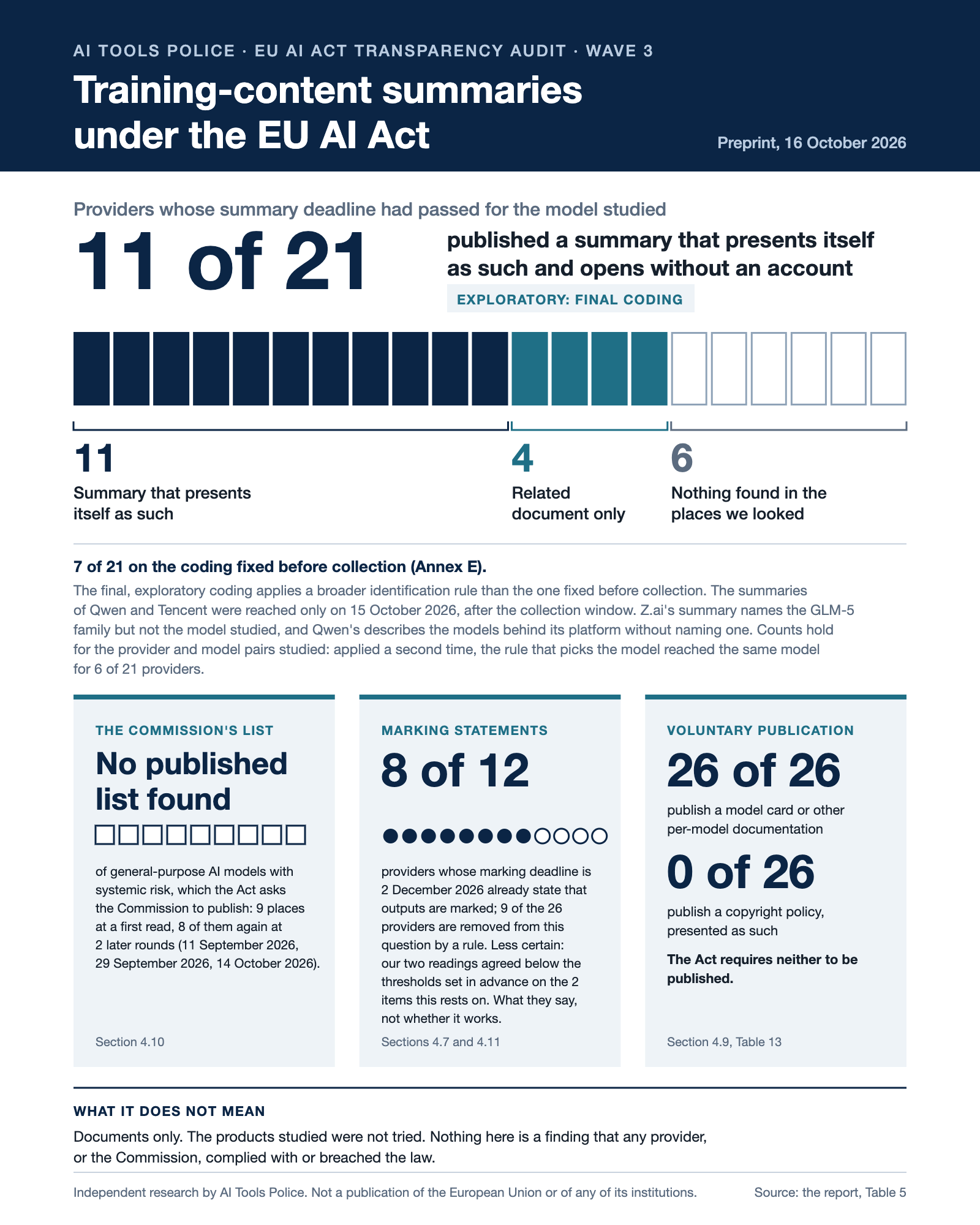
Found something wrong?
That is the outcome this release is built for. Corrections after the freeze are published errata with their date, not silent edits. Our corrections policy applies to research the same way it applies to reviews.
Independent research by AI Tools Police. This report is not a publication of the European Union or of any of its institutions, and it does not state their position.
See more of this work on Google
Google lets you name the sites you want to see more of. Adding AI Tools Police changes what Google shows you, not where we rank for anyone else, and it tells us nothing about you.